
The Basics of Industrial Bulk Material Conveyance
In industrial environments where bulk materials are constantly on the move, conveyance systems are the backbone of efficient operations. Whether moving aggregates, grain, powders, pellets, or by-products, selecting the right conveying method can significantly impact productivity, safety, maintenance costs, and overall system reliability.
This article breaks down the fundamentals of industrial conveyance; what it is, why it matters, and the most common systems used in bulk material handling applications.
What Is Conveyance?
Conveyance refers to the controlled movement of bulk materials from one point to another within a facility or across a site. In industrial bulk material handling, this typically involves mechanical systems designed to move large volumes of material efficiently, safely, and consistently.
A well-designed conveying system:
- Reduces manual handling and labour requirements.
- Improves throughput and process efficiency.
- Minimizes material loss and product damage.
- Enhances workplace safety and cleanliness.
Key Factors That Influence Conveying System Design
Before selecting a conveying solution, several variables must be considered:
1. Material Characteristics
Different materials behave very differently. Key properties include:
- Particle size and shape.
- Bulk density.
- Moisture content.
- Flowability and abrasiveness
These characteristics directly affect system selection, wear points, and maintenance requirements.
2. Capacity and Throughput
The required tons or bushels per hour will influence:
- Conveyor size and speed.
- Drive power and motor selection.
- Structural design and support requirements.
3. Distance and Elevation
Horizontal runs, inclines, and vertical lifts each demand different conveying technologies. Elevation changes often introduce the greatest mechanical challenges.
4. Environmental Conditions
Outdoor exposure, dust control requirements, temperature extremes, and corrosion risks all play a role in system design and material selection.
Common Types of Industrial Conveyance Systems
Belt Conveyors
Belt conveyors are among the most widely used conveying systems in industrial applications.
Best suited for:
- Long-distance transport.
- High-capacity, continuous flow.
- Gentle handling of materials.
Key advantages:
- Energy efficient.
- Low material degradation.
- Flexible layout options.
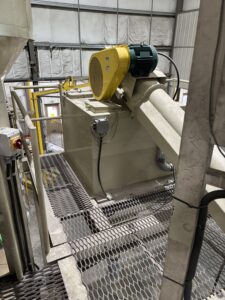
Screw Conveyors (Augers)
Screw conveyors use a rotating helical flight to move material through a trough or tube.
Best suited for:
- Short to medium distances.
- Controlled feed applications.
- Powders and fine materials.
Key advantages:
- Compact design.
- Enclosed for dust control.
- Precise material metering.
Drag Conveyors
Drag conveyors move material using paddles or flights inside and enclosed casing.
Best suited for:
- Abrasive or dusty materials.
- Multiple inlet and discharge points.
- Low-speed, controlled movement.
Key advantages:
- Fully enclosed design.
- Reduced dust emissions.
- Minimal material degradation.
Bucket Elevators
Bucket elevators are designed for vertical conveying, lifting material using buckets attached to a belt or chain.
Best suited for:
- Vertical lifts in limited floor space.
- High-capacity applications.
- Grain, aggregates, and industrial bulk products.
Key advantages:
- Efficient vertical transport.
- Small footprint.
- High throughput capacity.
Why Proper Conveyance Matters
A poorly designed or outdated conveying system can create bottlenecks, increase downtime, and drive up maintenance costs. Conversely, a properly engineered solution can:
- Extend equipment life.
- Improve system reliability.
- Reduce operating costs.
- Support future expansion.
At ACi, conveyance is never treated as a one-size-fits-all solution. Every system is evaluated based on the material, process requirements, and long-term operational goals.
Partnering with ACi
 From concept and layout to fabrication, installation, and ongoing service, ACi delivers complete bulk material handling solutions. Our team understand show conveyance integrates with structural steel, electrical systems, automation, and plant operations, ensuring each system performs as intended.
If you are planning a new installation, system upgrade, or capacity expansion, our team can help you design a conveying solution that works today and scales for tomorrow. To contact one of our team members, call 519 759 5880 (Brantford Office), or 613 652 1010 (Brinston Office), email sales@aci-industrial.com, or fill out the contact form below.