Agriculture & Processing, bulk material handling, Engineering & Design, Industrial Infrastructure

Bulk Material Storage 101: The Basics Every Facility Should Know
ACi Industrial bulk material storage 101 blog header featuring company logo and headline text.
Bulk Material Storage 101 - Understanding the fundamentals of effective bulk material storage and system design

Bulk material storage is a foundational element of many industrial, agricultural, and processing operations. Whether you’re handling grain, aggregates, minerals, powders, or by‑products, how materials are stored has a direct impact on efficiency, safety, product quality, and long‑term operating costs.

In this article, we break down the basics of bulk material storage: what it is, what influences its design, the most common storage types, and why getting it right matters.

What is Bulk Material Storage?

Bulk material storage refers to systems and structures used to hold large quantities of loose, unpackaged materials. These materials are typically stored before processing, shipping, blending, or distribution and can range from free‑flowing products like grain and plastic pellets to more challenging materials such as sticky powders, damp aggregates, or fibrous commodities.

The primary goal of bulk storage is simple: store material reliably while preserving quality and enabling controlled, efficient flow when needed. Achieving that goal, however, requires thoughtful design and an understanding of how materials behave under real‑world conditions.

Key Factors That Influence Storage Design

No two bulk materials behave the same, and no two operations have identical requirements. Several critical factors influence how a bulk storage system should be designed:

1. Material Characteristics

The physical properties of the material are often the most important design driver. These include:

  • Particle size and shape
  • Bulk density
  • Moisture content
  • Flowability and angle of repose
  • Abrasiveness or corrosiveness

Materials that flow easily may require minimal intervention, while cohesive or abrasive materials demand specialized liners, steeper hopper angles, or mechanical discharge aids.

2. Capacity and Throughput

How much material needs to be stored—and how quickly it must move in and out of storage—shapes everything from structure size to discharge design. High‑throughput operations may prioritize mass flow and automation, while long‑term storage may focus more on preservation and environmental protection.

3. Environmental Conditions

Outdoor exposure, temperature swings, humidity, and wind loads all affect storage design. For agricultural and food‑grade materials, moisture control and pest mitigation are especially important. Industrial materials may require dust control, corrosion resistance, or freeze‑prevention measures.

4. Site Constraints and Regulations

Available footprint, height restrictions, existing infrastructure, and local codes all play a role. Compliance with safety, environmental, and industry‑specific regulations must also be factored into the design from the outset.

Common Types of Bulk Material Storage

While storage solutions are highly customizable, most systems fall into a few common categories:

Bins & Silos

Silos and bins are among the most widely used bulk storage structures. They are well‑suited for grain, powders, pellets, and other dry bulk materials. Designs vary based on discharge method, material behavior, and whether inventory rotation is required.

Flat Storage & Warehousing

Flat storage facilities use floors, bunkers, or push‑walls to store bulk materials in piles. This approach provides flexibility and high capacity but often requires mobile equipment for handling and reclaiming material.

Hoppers & Surge Bins

Hoppers and surge bins are typically used for short‑term or inline storage. They help regulate flow between processes, buffer production variations, and ensure consistent downstream feeding.

Tanks & Specialized Vessels

For materials that are semi‑dry, slurry‑based, or sensitive to contamination, tanks or lined vessels may be used. These systems often integrate temperature control, agitation, or sealing to preserve material integrity.

Why Bulk Material Storage Matters

Bulk storage is more than just a holding point, it's a strategic asset within an operation.

Operational Efficiency

Poorly designed storage can cause flow issues, bottlenecks, and downtime. Well‑engineered systems improve material flow, reduce handling steps, and support automation.

Safety

Stored bulk materials exert significant loads and can pose risks such as structural failure, dust explosions, or engulfment hazards. Proper design and engineering are essential to protecting people and assets.

Product Quality and Loss Prevention

Exposure to moisture, temperature extremes, or contamination can degrade materials and lead to costly losses. Effective storage helps maintain quality and minimize spoilage, segregation, and shrink.

Long-Term Cost Control

While upfront investment matters, lifecycle performance matters more. Storage systems that are designed correctly from the start reduce maintenance requirements, extend service life, and support future expansion.

Final Thoughts

Bulk material storage is a critical, but often underestimated component of industrial and agricultural systems. From understanding material behavior to selecting the right storage type and designing for real‑world conditions, thoughtful planning pays dividends in safety, efficiency, and reliability.

At ACi, we approach bulk material storage as an integrated system, not just a structure. By aligning storage design with operational goals, we help facilities build solutions that perform today and adapt for tomorrow.

Contact Us
ACi Industrial logoIf you’re considering a new storage system or evaluating existing infrastructure, understanding the basics is the first step toward getting it right.  To contact one of our team members, call 519 759 5880 (Brantford Office), or 613 652 1010 (Brinston Office), email sales@aci-industrial.com, or fill out the contact form below.


Contact Us

Engineering Insights, Industrial Optimization, Operations & Maintenance, Uncategorized

Optimizing Throughput Without Replacing Equipment

ACi Industrial optimizing throughput without replacing equipment
Smarter upgrades, better controls, and targeted bottleneck fixes can unlock hidden capacity in existing systems.

When production demands increase, the instinctive response is often to invest in new equipment.  While capital upgrades have their place, they’re not always the fastest, or most cost-effective path to higher throughput.  In many facilities, existing systems are capable of more than they’re currently delivering.

With the right mix of targeted upgrades, smarter controls, proper tuning, and bottleneck elimination, significant throughput gains can often be unlocked without replacing major equipment.

Start With the Real Constraint

Every system has at least one constraint that limits overall production. Increasing speed or capacity elsewhere won’t help if the bottleneck remains untouched.

Common industrial bottlenecks include:

  • Conveyor transitions or underpowered drives
  • Accumulation points causing intermittent stoppages
  • Manual interventions slowing automated processes
  • Inconsistent feed rates or flow control issues

A structured bottleneck analysis consisting of observing where material backs up, where machines wait, or where operators intervene, is often the fastest way to identify opportunities.

Upgrade What Matters, Not Everything

Selective component upgrades can dramatically improve performance without wholesale replacement:

  • Motors & Drives: Upgrading to modern, properly sized motors or adding variable frequency drives (VFDs) improves control, reduces stress, and maximizes usable capacity.
  • Sensors & Instrumentation: Modern sensors provide faster, more reliable feedback for controls systems, reducing nuisance stops and improving flow consistency.
  • Mechanical Wear Components: Chains, belts, lagging, bearings, and wear liners can quietly become throughput limiters as they degrade.

These upgrades target system weaknesses rather than replacing assets that still have usable life.

Controls Optimization Unlocks Hidden Capacity

Many facilities run on control logic that hasn’t changed since commissioning. Controls platforms may be functioning but not optimized.

Improvements often include:

  • Fine-tuning start/stop sequencing to reduce downtime
  • Improving interlocks to prevent unnecessary system trips
  • Adjusting ramp-up and ramp-down logic on drives
  • Adding diagnostics that allow faster troubleshooting

In some cases, modest PLC or HMI updates can deliver throughput improvements that rival major mechanical changes.

Tune the Process, Not Just the Equipment

Even well-designed systems can underperform if they’re not tuned correctly. Feed rates, speeds, dwell times, and accumulation parameters all affect throughput.

Process tuning focuses on:

  • Matching equipment speeds across the system
  • Reducing excessive safety margins that limit output
  • Stabilizing flow to prevent surging or starvation
  • Aligning upstream and downstream operations

Small adjustments, validated through testing, often produce measurable gains with minimal risk.

Fix Chronic Downtime Before Adding Capacity

Throughput isn’t just about speed; it’s also about consistency. Chronic downtime from jams, misalignment, or manual resets erodes capacity every shift.

Addressing recurring issues such as:

  • Material hang-ups
  • Poor dust management
  • Inadequate guarding access for maintenance
  • Inconsistent product characteristics

can recover lost production time without increasing system speed at all.

Incremental Improvements, Compounding Results

The most successful throughput improvements come from stacking small, targeted gains:

  • A few percent from controls tuning
  • A few percent from mechanical upgrades
  • A few percent from downtime reduction

Together, these changes can deliver double-digit throughput improvements without the cost, risk, or disruption of major equipment replacement.

How ACi Helps

ACi Industrial works with facilities to identify practical, cost-effective ways to get more from existing systems. With in-house millwrighting, electrical, controls, and fabrication expertise, ACi can:

  • Identify true system constraints
  • Design and implement targeted upgrades
  • Optimize controls and automation
  • Execute improvements safely and efficiently

If your equipment is running but not reaching its potential, there’s likely opportunity waiting to be unlocked.

Contact Us

ACi Industrial logoIf you are planning a new installation, system upgrade, or capacity expansion, our team can help you design a conveying solution that works today and scales for tomorrow.  To contact one of our team members, call 519 759 5880 (Brantford Office), or 613 652 1010 (Brinston Office), email sales@aci-industrial.com, or fill out the contact form below.

Contact Us

design & fabrication, industrial engineering, maintenance & reliability

Designing for Maintenance & Longevity: Why Access and Serviceability Matter

Graphic featuring the text “Designing for Maintenance and Longevity” above the ACi Industrial logo, highlighting industrial design focused on long‑term serviceability.
Designing industrial systems with access, serviceability, and long‑term performance in mind.

In industrial environments, equipment performance is often judged by capacity, throughput, or efficiency.  But over the full life of an asset, another factor quietly drives cost, safety, and uptime: how well the system was designed to be maintained.

At ACi, we believe that good design doesn’t stop at startup.  The most successful systems are those that remain serviceable, safe, and cost-effective years, or event decades, after installation.  That longevity starts with intentional design choices around access, liners, guarding, and serviceability.

Maintenance Isn't an Afterthought - It's a Design Requirement

Maintenance teams interact with equipment far more often than designers or installers ever will.  When systems are difficult to access, require excessive disassembly, or expose workers to hazards, the result is predictable: longer downtime, higher costs, and increased risk.

Designing for maintenance means asking critical questions early in the process:

  • How will this component be inspected?
  • How often will wear parts need replacement?
  • Can service be completed safely without shutting down large sections of the plant?
  • What will this look like 10 or 20 years from now?

By addressing these questions up front, we help ensure equipment that supports, not hinders, long term operations.

Access: Making the Right Things Reachable

Safe, intentional access is the foundation of serviceable design.  Platforms, ladders, walkways, and access doors shouldn’t be retrofits or compromises, they should be part of the original layout.

Proper access allows maintenance teams to:

  • Perform inspections without bypassing safety measures.
  • Address issues early before they escalate.
  • Complete routine tasks faster and with greater confidence.

When access is poorly designed, even simple jobs become time-consuming and hazardous.  At ACi, we design layouts that recognize how people actually work in the field, not just how equipment looks on a drawing.

Liners: Planning for Wear, Not Reacting to It

Wear is inevitable in material handling and industrial environments, but excessive disruption doesn’t have to be.

Replaceable liners are a critical element of long-term durability.  Designing equipment with liners that are:

  • Easy to remove and replace.
  • Segmented where possible.
  • Accessible without major teardown.

Allows wear surfaces to be addressed efficiently without damaging the underlying structure.  This approach extends the life of the equipment while minimizing downtime and labour costs.

Good liner design also supports safer maintenance, reducing confined-space work and awkward material handling during replacement.

Guarding: Protecting People Without Preventing Maintenance

Safety guarding is essential, but guard design must balance protection with practicality.

Poorly designed guarding can:

  • Obstruct access to service points.
  • Encourage unsafe workarounds.
  • Increase maintenance time unnecessarily.

Effective guarding protects workers while still allowing safe inspection, lubrication, adjustment, and replacement tasks.  Hinged, removable, or strategically segmented guarding solutions help maintenance teams do their jobs properly, without compromising safety or efficiency.

At ACi, we design guarding that works with maintenance, not against it.

Serviceability: Reducing Downtime Across the Asset Life

Serviceability is where all these elements come together.  A serviceable system is one that:

  • Can be inspected quickly and safely.
  • Allows common wear parts to be replaced efficiently.
  • Minimizes disruption to surrounding equipment.
  • Supports predictable maintenance schedules.

Over the life of a system, these advantages compound.  Reduced downtime, lower labour hours, fewer emergency repairs, and improved safety performance all translate directly into lower total cost of ownership.

The result is equipment that doesn’t just meet today’s production targets, but continues to deliver value for years to come.

Lifecycle Thinking Pays Off

Capital projects are often evaluated on upfront cost, but the real financial impact emerges over time.  Systems designed without maintenance in mind frequently cost more in lost production, repairs, and safety incidents than they ever saved during installation.

Designing for maintenance and longevity is about protecting your investment.  It’s about recognizing that the easiest time to improve serviceability is before the equipment is built.

Built for the Long Run

At ACi, we bring maintenance awareness into the design process from day one.  By prioritizing access, liners, guarding, and serviceability, we help our clients build systems that are safer, easier to maintain, and far more durable over their lifespan.

Because the best designs don’t just perform on day one, they keep performing, year after year.

Contact Us

ACi Industrial logoIf you are planning a new installation, system upgrade, or capacity expansion, our team can help you design a conveying solution that works today and scales for tomorrow.  To contact one of our team members, call 519 759 5880 (Brantford Office), or 613 652 1010 (Brinston Office), email sales@aci-industrial.com, or fill out the contact form below.


Contact Us

bulk material handling, Engineering & Design, Industrial Systems

The Basics of Industrial Bulk Material Conveyance

ACi Industrial logo with green gear icon and the headline “The Basics of Conveyance in Industrial Bulk Material Handling
An overview of industrial bulk material conveyance systems, including common methods used to move materials efficiently and safely.

In industrial environments where bulk materials are constantly on the move, conveyance systems are the backbone of efficient operations.  Whether moving aggregates, grain, powders, pellets, or by-products, selecting the right conveying method can significantly impact productivity, safety, maintenance costs, and overall system reliability.

This article breaks down the fundamentals of industrial conveyance; what it is, why it matters, and the most common systems used in bulk material handling applications.

What Is Conveyance?

Conveyance refers to the controlled movement of bulk materials from one point to another within a facility or across a site.  In industrial bulk material handling, this typically involves mechanical systems designed to move large volumes of material efficiently, safely, and consistently.

A well-designed conveying system:

  • Reduces manual handling and labour requirements.
  • Improves throughput and process efficiency.
  • Minimizes material loss and product damage.
  • Enhances workplace safety and cleanliness.

Key Factors That Influence Conveying System Design

Before selecting a conveying solution, several variables must be considered:

1. Material Characteristics

Different materials behave very differently.  Key properties include:

  • Particle size and shape.
  • Bulk density.
  • Moisture content.
  • Flowability and abrasiveness

These characteristics directly affect system selection, wear points, and maintenance requirements.

2. Capacity and Throughput

The required tons or bushels per hour will influence:

  • Conveyor size and speed.
  • Drive power and motor selection.
  • Structural design and support requirements.

3. Distance and Elevation

Horizontal runs, inclines, and vertical lifts each demand different conveying technologies.  Elevation changes often introduce the greatest mechanical challenges.

4. Environmental Conditions

Outdoor exposure, dust control requirements, temperature extremes, and corrosion risks all play a role in system design and material selection.

Common Types of Industrial Conveyance Systems

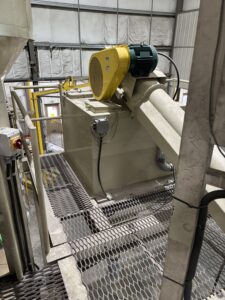
Industrial screw conveyor with motor and gearbox mounted on an elevated steel platform inside a bulk material handling facility.
A heavy‑duty screw conveyor with a motor and gearbox mounted on a grated service platform, designed for controlled material transfer within an industrial processing system.
Belt Conveyors

Belt conveyors are among the most widely used conveying systems in industrial applications.

Best suited for:

  • Long-distance transport.
  • High-capacity, continuous flow.
  • Gentle handling of materials.

Key advantages:

  • Energy efficient.
  • Low material degradation.
  • Flexible layout options.
Screw Conveyors (Augers)

Screw conveyors use a rotating helical flight to move material through a trough or tube.

Best suited for:

  • Short to medium distances.
  • Controlled feed applications.
  • Powders and fine materials.

Key advantages:

  • Compact design.
  • Enclosed for dust control.
  • Precise material metering.
Drag Conveyors

Drag conveyors move material using paddles or flights inside and enclosed casing.

Best suited for:

  • Abrasive or dusty materials.
  • Multiple inlet and discharge points.
  • Low-speed, controlled movement.

Key advantages:

  • Fully enclosed design.
  • Reduced dust emissions.
  • Minimal material degradation.
Bucket Elevators

Bucket elevators are designed for vertical conveying, lifting material using buckets attached to a belt or chain.

Best suited for:

  • Vertical lifts in limited floor space.
  • High-capacity applications.
  • Grain, aggregates, and industrial bulk products.

Key advantages:

  • Efficient vertical transport.
  • Small footprint.
  • High throughput capacity.

Why Proper Conveyance Matters

A poorly designed or outdated conveying system can create bottlenecks, increase downtime, and drive up maintenance costs.  Conversely, a properly engineered solution can:

  • Extend equipment life.
  • Improve system reliability.
  • Reduce operating costs.
  • Support future expansion.

At ACi, conveyance is never treated as a one-size-fits-all solution.  Every system is evaluated based on the material, process requirements, and long-term operational goals.

Partnering with ACi

ACi Industrial logoFrom concept and layout to fabrication, installation, and ongoing service, ACi delivers complete bulk material handling solutions.  Our team understand show conveyance integrates with structural steel, electrical systems, automation, and plant operations, ensuring each system performs as intended.

If you are planning a new installation, system upgrade, or capacity expansion, our team can help you design a conveying solution that works today and scales for tomorrow.  To contact one of our team members, call 519 759 5880 (Brantford Office), or 613 652 1010 (Brinston Office), email sales@aci-industrial.com, or fill out the contact form below.
bulk material handling, industrial automation, process optimization, smart technology, Uncategorized

Automation & Smart Technology in Bulk Material Handling: How Industrial Facilities are Boosting Efficiency in 2026

ACi Industrial graphic showing automation and smart technology in bulk material handling, featuring a robotic arm transferring bags on a conveyor.
Automation and smart technology solutions help industrial facilities improve efficiency, reduce downtime, and address labour challenges in bulk material handling operations.

Labour shortages, rising operating costs, and increasing production demands are pushing industrial facilities to rethink how they move, monitor, and manage bulk materials. Across Canada, plants are adopting automation and smart technologies to solve long-standing challenges, such as unplanned downtime, inconsistent throughput, and reliability issues caused by aging infrastructure.

As more facilities modernize, one trend is clear: automation isn’t a future investment anymore, it’s now a core part of efficient, safe, and scalable bulk material handling systems.

In this article, we explore the top automation technologies transforming industrial operations in 2026, and how they directly improve performance on the plant floor.

AGVs and AMRs: Transforming Material Movement Without Adding Labour

Automated Guided Vehicles (AGVs) and Autonomous Mobile Robots (AMRs) are becoming a key solution for facilities struggling with labour shortages or inconsistent availability of forklift operators.

What They Do
  • Move raw materials, finished goods, or bulk components between workstations.
  • Reduce reliance on manual transport.
  • Operate continuously with predictable cycle times.
Benefits to Material Handling
  • Smoother, more predictable throughput.
  • Reduced labour costs and operator fatigue.
  • Improved safety by removing manual forklift traffic from busy aisles.
  • Consistent flow, especially during peak periods or shift changes.

For facilities that frequently move totes, bins, super sacks, pallets, or bulk loads internally, AMRs and AGVs provide measurable efficiency gains with minimal disruption to existing layouts.

Predictive Maintenance: Stopping Failures Before They Shut You Down

Unplanned downtime remains one of the most expensive risks for bulk handling operations.  When a conveyor, feeder, or bucket elevator goes down, the entire production process slows down, or stops completely.

Predictive maintenance uses sensors, data models, and automated alerts to identify issues before a failure occurs.

What Predictive Maintenance Identifies
  • Bearing wear
  • Motor temperature anomalies.
  • Belt misalignment.
  • Vibration patterns that signal upcoming mechanical failures.
  • Gearbox deterioration.
Why Facilities Are Adopting It
  • Reduces downtime.
  • Lowers maintenance costs.
  • Eliminates guesswork from shutdown planning.
  • Extends the lifespan of equipment.

This technology is especially valuable for conveyors, which are typically the highest-maintenance, and highest-impact assets in any bulk handling system.

AI & Machine Learning: Smarter Decisions, Faster Corrections

AI-powered optimization helps plants maintain consistent flow rates and reduce bottlenecks.  Machine learning algorithms can analyze months of equipment and production data to recommend or automatically execute adjustments.

Where AI Creates Value
  • Optimizing conveyor speeds based on material flow.
  • Balancing feed rates to prevent overloading.
  • Detecting anomalies faster than manual monitoring.
  • Learning from historical trends to recommend settings.

For bulk material handling, where even small inconsistencies cause significant downstream issues, AI provides a layer of control that human operators can't sustain manually 24/7.

IoT Sensors: Real-Time Visibility for Flow, Moisture, Temperature and More

IoT sensors give operators the ability to monitor each stage of material movement, from storage to discharge to conveying, in real time.

Common Sensor Applications
  • Flow monitoring: Detects bridging, ratholing, or slow discharge from silos.
  • Moisture sensing: Critical for grain, powders, fertilizers, and aggregates.
  • Temperature sensing: Helps prevent overheating in motors and bearings.
  • Vibration sensing: Early detection of mechanical issues.
  • Level monitoring: Accurate inventory data for silos and bins.
The Result
  • Less manual inspection.
  • Faster response to flow issues.
  • Better planning for production and purchasing.
  • Increased safety through earlier detection of system failures.

Automated Bagging & Palletizing: Increasing Throughput and Reducing Manual Labour

Packaging is one of the biggest bottlenecks for manufacturers and processors.  Automated bagging and palletizing systems eliminate repetitive strain tasks and keep packaging output consistent, even when labour is limited.

Automation Capabilities
  • Bag filling.
  • Weighing.
  • Sealing.
  • Labeling.
  • Robotic palletizing.
Why Plants Are Upgrading
  • Often faster than manual labour.
  • Improved accuracy and weight control.
  • Fewer injuries from repetitive lifting.
  • Continuous output, even during shift gaps.

For facilities handling grain, fertilizer, food ingredients, plastics, minerals, or chemicals, automated packaging lines offer one of the quickest ROI paths in the automation category.

Bringing It All Together: A Smarter, Safer, More Efficient Operation

When combined, these technologies create an ecosystem where:

  • Material flow is predictable.
  • Equipment performance is monitored continuously.
  • Throughput is optimized automatically.
  • Labour requirements are reduced.
  • Safety risks are minimized.

ACi helps facilities integrated automation into existing bulk material handling systems without disrupting production.  From conveyors and storage to sensing, data, and controls, we provide engineered solutions that reduce downtime and deliver consistent and measurable performance.

Contact Us

ACi Industrial logoTo learn more and discuss how we can help your business operations, contact one of our team members today by calling 519 759 5880 (Brantford Office), or 613 652 1010 (Brinston Office), email sales@aci-industrial.com, or fill out the contact form below.
Contact Us

automation and technology, facility planning & execution, industrial construction, Industry Trends, Uncategorized

Turning Insight In to Action: How to Finalize Your Facility Strategy

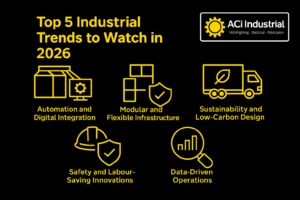
Branded ACi Industrial graphic showing the top five industrial trends for 2026, including automation, modular infrastructure, sustainability, safety innovations, and data-driven operations, with icons and ACi’s logo in ACi colours.
A visual overview of the five industrial trends shaping 2026: automation, modular infrastructure, sustainability, safety-focused design, and data-driven operations—presented in ACi Industrial’s colours and branding.

This article builds on our earlier review of the Top Industrial Trends for 2026 and the follow-up consideration-stage guide on how those trends influence facility planning.  If you’ve reached the point of evaluating your options and preparing for an investment, this decision-stage version is designed for you.

Industrial organizations across Ontario and beyond are now moving from research to action.  The trends driving change in 2026: automation, modular construction, sustainability, safety innovation, and data-driven operations are no longer theoretical.  They influence how projects are scoped, what technology is selected, how timelines are structured, and which partners are most capable of delivering.

Below is a clear, decision-oriented breakdown of what companies should finalize as they prepare to move forward with upgrades, expansions, or new builds.

1. Automation & Digital Integration: Final Decisions to Make

Automation is no longer simply a competitive advantage, it’s an operational requirement.  At this stage, organizations are determining which systems to integrate, how they will connect, and which vendor can ensure reliability and support. 

Key decisions now include:
  • Defining your controls architecture: PLC/SCADA standardization, communication protocols, and expansion capacity.
  • Selecting equipment that supports data and automation rather than locking you into outdated or standalone systems.
  • Confirming remote monitoring and cybersecurity requirements for your IT/OT environment.
  • Finalizing fail-safe logic and E-stop integration to meet compliance.

At this stag, the question is no longer “Should we automate?” but “Who will implement it, and how do we future-proof it?”

2. Modular & Flexible Infrastructure: Aligning Design With Schedule & Budget

Modular and prefabrication approaches reduce downtime and construction risk, but each project requires choosing the right balance of prefab vs. site-built elements.

Decision-stage considerations:
  • Confirming whether modular assemblies will reduce shutdown time enough to justify their use.
  • Finalizing structural standards (steel gauge, coatings, load ratings, accessibility requirements).
  • Coordinating modular components with civil, mechanical, and electrical scopes.
  • Locking in realistic installation timelines that align with production seasons or turnaround windows.

This is the moment where conceptual layouts become construction-ready designs.

3. Sustainability & Low-Carbon Design: Selecting the Right Tactics

Most organizations now face clear emissions, reporting, or energy-efficiency expectations.  Decision-makers are choosing which sustainability measures to implement and which to hold for future phases.

Common decisions at this stage:
  • Whether to adopt energy-efficient fans, motors, lighting, or HVAC as part of the upgrade.
  • Whether a site layout redesign can genuinely reduce internal traffic and fuel use.
  • Selecting materials and building standards that support long-term sustainability metrics.
  • Choosing systems that allow emissions data and energy use to be measured automatically.

Instead of exploring possibilities, this phase focuses on finalizing the strategies that align with your KPIs and compliance needs.

4. Safety & Labour-Saving Innovations: Engineering Out Risk

By the decision stage, most organizations have already assessed their high-risk areas.  Now they must finalize which engineered controls and design choices will mitigate those risks.

Critical decisions include:
  • Determining which elevated work areas require permanent access (stairs, platforms, catwalks).
  • Finalizing guarding, dust control, and explosion mitigation systems.
  • Selecting modular solutions that reduce construction time and limit worker exposure.
  • Choosing workflow-driven interior fit-ups that reduce bottlenecks and improve throughput.

This is where safety moves from “planning” to implementation and verification.

5. Data-Driven Operations: Confirming the Digital Roadmap

At this stage, organizations have typically identified where data will create value.  Now they must finalize their system architecture and technology stack.

Decision-phase checkpoints:
  • Selecting the sensors, monitoring tools, and reporting platforms that best fit your operation.
  • Confirming the data flow from equipment ->controls ->dashboards -> reporting
  • Establishing maintenance and reliability metrics MTBF, MTTR, condition-based triggers).
  • Ensuring scalability so future equipment integrates seamlessly.

This is where digital transformation becomes a defined, deliverable scope and not just a concept.

Bringing It All Together: Your 2026 Project Roadmap

If you’ve reached the decision stage, you’ve likely completed:

  • Understanding the trends.
  • Evaluating what matters to your facility.
  • Outlining your goals and internal requirements.

Now your focus shifts to:

  • Selecting the right partner(s).
  • Finalizing project scope, timeline, and budget.
  • Confirming standards, drawings, and specifications.
  • Planning site preparation and construction sequencing.
  • Booking fabrication, long-lead items, and installation windows.

This is where projects move from planning to execution.

Contact Us

ACi Industrial logoWant to learn more and discuss how to implement these trends in your business operations?  Contact one of our team members today by calling 519 759 5880 (Brantford Office), or 613 652 1010 (Brinston Office), email sales@aci-industrial.com, or fill out the contact form below.


Contact Us

Industrial Maintenance, Industrial Operations, Manufacturing & Production, Millwrighting Services, Shutdown & Turnaround Support, Uncategorized

Reduce Downtime During Scheduled Shutdowns With Custom Millwrighting Support

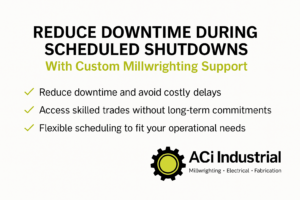
Graphic highlighting benefits of ACi Industrial’s custom millwrighting support during scheduled shutdowns, featuring key points and the ACi Industrial logo.
ACi Industrial provides flexible, skilled millwrighting support to help industrial facilities reduce downtime, avoid costly delays, and complete scheduled shutdowns efficiently.

In industrial operations, schedule shutdowns and planned maintenance windows are critical opportunities to improve equipment performance, increase safety, and prevent unexpected failures.  But they also present a major challenge: how do you complete essential work without stretching timelines, overrunning budgets, or creating new delays that impact production?

That's where ACi's custom millwrighting services make the difference.

Our team provides skilled labour and flexible service solutions to support your crew or work alongside other trades, helping you keep your facility running at peak efficiency before, during, and after your shutdown.

Why Custom Millwrighting Matters During Scheduled Shutdowns

Shutdowns are inherently high-pressure environments.  Multiple contractors are on-site, equipment is offline, and a single issue can throw off the entire schedule.

ACi strengthens your team with experienced millwrights who understand how to work safely, efficiently, and collaboratively in these conditions.  Whether you require temporary labour, specialized mechanical support, or full-service millwrighting for critical tasks, we help you complete shutdown projects on time and without disruption.

Key Benefits of ACi's Millwrighting Support

1. Reduce Downtime and Avoid Costly Delays

Unexpected issues during shutdown are a leading cause of extended downtime.  Our skilled millwrights help keep your schedule on track by:

  • Troubleshooting mechanical problems quickly
  • Providing rapid repairs or adjustments
  • Ensure equipment is reassembled and aligned correctly
  • Coordinating with your internal team and other trades to prevent bottlenecks

Every minute saved matters, and ACi ensures your equipment is ready to return to full production without unnecessary delays.

2. Access Skilled Trades Without Long-Term Commitments

Hiring and retaining in-house skilled labour can be costly for many industrial operations, especially when you only need additional manpower during peak maintenance periods.  ACi gives you access to:

You get the skillset you need only when you need it, without permanent staffing costs.

3. Flexible Scheduling to Fit Your Operational Needs

No two shutdowns look the same.  Some require weeks of preparation and multi-day downtime; others require rapid response and short duration work.  ACi adapts to your timeline with:

  • Day, night, and weekend availability
  • Full-shutdown, partial-shutdown, or ongoing support
  • Labour teams sized to your project needs
  • The ability to integrate seamlessly into your existing workforce

Our goal is simple: help you complete your maintenance window efficiently while minimizing disruption to your operations.

Supporting Your Facility for the Long Term

When you partner with ACi, you're gaining more than extra labour, you're gaining a long-term mechanical support team that understands your facility, your equipment, and your operational priorities.

Whether it's annual shutdowns, major equipment installs, emergency repairs, or preventative maintenance, we ensure your systems stay reliable and your production stays moving.

Contact Us

ACi Industrial logoACi is here to support your millwrighting and maintenance needs before, during, and after your scheduled shutdown.  Contact our team today to plan your shutdown support or request custom millwrighting services tailored to your facility.  Call 519 759 5880 (Brantford Office), 613 652 1010 (Brinston Office), email sales@aci-industrial.com, or fill out the contact form below.
Contact Us

Agricultural Technology and Innovation, facility planning & modernization, Grain Handling Solutions, Industry Trends, Uncategorized

From Awareness to Action: How 2026 Grain Handling Trends Impact Facility Planning

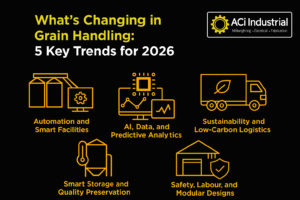
Illustration showing five key grain handling trends for 2026: automation and smart facilities, AI and predictive analytics, sustainability and low-carbon logistics, smart storage and quality preservation, and safety with modular designs.
Five major trends shaping grain handling in 2026: automation, AI-driven analytics, sustainability, smart storage, and safety-focused modular designs.

In our earlier post: What's Changing in Grain Handling and Why It Matters in 2026, we introduced the major forces reshaping grain handling this year.  As we move further into the year, we take this a step further to think about how these trends may apply to your site, your equipment, and your future planning.  This article focuses on the practical questions that grain elevators, terminals, and large farms are now asking as they evaluate modernization options for 2026 and beyond.

Automation & Smart Facilities: What Should You Evaluate?

Automation has shifted from a "nice-to-have" to a foundation of modern grain handling.  But the key question for many facilities is: Where should automation begin and how much integration is actually required?

Consideration Factors:
  • System fragmentation: Are receiving, conveying, drying, and loadout controlled separately?
  • Remote visibility: Would centralized dashboards or remote monitoring reduce manual checks or improve response times?
  • Scalability: Can your current PLC/SCADA setup support future expansions or added process areas?
  • Labour impact: Which tasks could automation safely eliminate or streamline?

Thinking through these questions helps narrow which automation upgrades will deliver the most meaningful ROI.

AI, Data & Predictive Analytics: Are You Data Ready?

AI and predictive analytics continue to expand in grain handling, but successful adoption depends on how well your facility already collects and organizes data.

What to Consider:
  • Sensor coverage: Which equipment (legs, belts, dryers, fans) lacks monitoring or trend data?
  • Data quality: Are current readings accurate, continuous, and accessible?
  • Integration needs: Will your existing controls feed data into an analytics platform?
  • Maintenance strategy: Where could predictive alerts reduce downtime or prevent failures?

These insights help teams determine whether to start with basic monitoring upgrades or explore full predictive maintenance analytics.

Smart Storage & Quality Preservation: What Level of Monitoring Makes Sense?

In our January article, we introduced continuous monitoring systems, which include the tracking of temperature, moisture and CO2.  Now the question becomes: How deep should monitoring go for your operation?

Consideration Factors:
  • Commodity sensitivity: Does grain variety, storage duration, or market requirements justify more advanced monitoring?
  • Inventory integration: Would automatic updates reduce manual checks or errors during busy seasons?
  • Aeration triggers: Is automated aeration control feasible or beneficial for your site?
  • Traceability requirements: Are you preparing for tighter quality or compliance standards?

Selecting the right sensor package is easier when tied to specific operational goals like shrink reduction, grade protection, or labour efficiency.

Sustainability & Low Carbon Logistics: What Changes Are Realistic?

New carbon rules and logistics pressures are reshaping grain movement.  The next stage is to identify what's achievable within their networks and facilities.

What to Consider:
  • Routing and mode shifts: Could certain lanes move to rail/intermodal to reduce carbon intensity?
  • Energy efficiency: Would upgrading fans, dryers, or conveyors materially affect energy use or emissions?
  • Reporting needs: Do you need data outputs for carbon reporting, ESG goals, or customer requirements?
  • Infrastructure limitations: What civil or structural constraints affect sustainability related upgrades?

This stage is about aligning sustainability goals with operational realities and regulatory timelines.

Safety, Labour, and Modular Designs: What Should You Prioritize?

Safer, modular, and labour saving equipment continues to grow in adoption.  The next step is deciding which improvements matter most at your site.

Consideration Factors
  • High-risk areas: Which tasks expose workers to heights, confined spaces, dust, or heavy manual handling?
  • Modular possibilities: Could portable or modular units reduce construction downtime or improve flexibility?
  • Access and guarding: Which parts of your facility need better guarding, catwalks, or engineered access?
  • Workforce availability: Are labour shortages or seasonal bottlenecks impacting operations?

Facilities that assess safety in the context of workflow, equipment design, and plant layout tend to gain both compliance and efficiency benefits.

Contact Us

ACi Industrial logoWant to learn more and discuss how these trends may impact your business operations?  Contact one of our team members today by calling 519 759 5880 (Brantford Office), or 613 652 1010 (Brinston Office), email sales@aci-industrial.com, or fill out the contact form below.
 

Contact Us

automation and technology, facility planning & modernization, industrial construction, Industry Trends, Uncategorized

How 2026 Industrial Trends Influence Facility Planning

Branded ACi Industrial graphic showing the top five industrial trends for 2026, including automation, modular infrastructure, sustainability, safety innovations, and data-driven operations, with icons and ACi’s logo in ACi colours.
A visual overview of the five industrial trends shaping 2026: automation, modular infrastructure, sustainability, safety-focused design, and data-driven operations—presented in ACi Industrial’s colours and branding.

Last month we explored 5 Emerging Trends that are poised to shape the industrial landscape.  Now that you're familiar with those trends, this follow-up is designed to help you move from understanding what's changing to evaluating how these changes may apply to your facility and future projects.

Industrial operations are under increasing pressure to modernize.  But modernization isn't one-size-fits-all.  The same five trends shaping the broad sector: automation, modular design, sustainability, safety, and data-driven operations, raise different questions depending on your facility layout, equipment, constraints, and long-term growth plans.

Below, we revisit these trends with a more practical perspective, focusing on the factors your team should evaluate when planning upgrades, expansions, or infrastructure changes in 2026 and beyond.

1. Automation and Digital Integration

Previously, we explored how automation is becoming essential for efficiency and uptime.  As we move forward, the focus shifts toward assessing operational impact.

What to evaluate now:
  • How fragmented are your current control systems?  If different process areas run on standalone platforms, integration may offer measurable efficiency gains.
  • Where could remote monitoring reduce manual intervention?  Identify high-risk or high-labour zones where digital monitoring could improve safety or reduce downtime.
  • How scalable are your existing PLC/SCADA systems?  Consider whether your current architecture will accommodate future equipment, buildings, or process expansions.

Automation decisions at this stage should align with both current bottlenecks and long-term operational goals.

2. Modular and Flexible Infrastructure

Our previous article introduced modular and prefabricated construction as an emerging standard.  Now the question becomes: Is this approach right for your project?

Consider:
  • How much downtime can your operational realistically accommodate?  Modular builds can reduce on-site disruption during critical seasons.
  • Does your facility need the ability to expand or reconfigure?  Flexible layouts are especially valuable for growing or variable-demand industries.
  • What constraints exist on your site?  Soil conditions, space limitations, and existing building tie-ins all influence the feasibility of modular steel structures or prefabricated assemblies.

Modular solutions are particularly useful when your project requires speed, scalability, or controlled installation environments.

3. Sustainability and Low-Carbon Design

Sustainability is increasingly tied to compliance, cost savings, and long-term resilience.  As you progress through this review, organizations begin examining practical pathways to meet these expectations.

Key evaluation points:
  • Energy Efficiency: What equipment, building designs, or layout changes could reduce operational energy use?
  • Material Selection: How do steel, concrete, insulation, and coatings factor into lifecycle impact and durability?
  • Carbon and Emissions Requirements: Are you subject to new reporting frameworks or internal Environmental, Social and Governance (ESG) goals?
  • Process Optimization: Could redesign material handling paths or storage layouts decrease emissions from internal movement?

This trend is specifically relevant for companies preparing for capital investments over the next one to three years.

4. Safety and Labour-Saving Innovations

Reducing risk exposure and minimizing tasks were major points in our previous article.  As you progress to the next stage, the goal is to determine which specific areas of your operation could see the most immediate improvement.

Evaluation criteria:
  • Where are your highest-risk tasks located?  Elevated work areas, confined spaces, and manual handling steps are common targets.
  • Are dust, noise, or ergonomic factors impacting operations?  These issues often signal the need for upgrades in guarding, ventilations, or interior fit-up designs.
  • Could workflow redesign reduce congestion or improve throughput?  Workspaces with inefficient flow often hide safety risks and opportunities for optimization.

Safety-driven upgrades not only reduce incidents but also support labour efficiency and retention.

5. Data-Driven Operations

We previously introduced sensors, predictive maintenance, and data visibility as rising priorities.  Now the question becomes: Is your facility ready to leverage operational data meaniningfully?

What to assess:
  • Where would real-time monitoring provide the highest ROI?  Critical assets (material handling systems, power distribution, environmental controls) often yield quick wins.
  • Is your current data actionable?  May facilities collect data but lack dashboards or analytics that support decision-making.
  • What integrations are required to unify your digital ecosystem?  Electrical and automation upgrades may be necessary to connect sensors, equipment, and reporting tools.

Data-driven improvements work best aligned with clear operational goals around reliability, uptime, quality, or energy management.

Preparing for the Decision Stage

As you start to understand the big picture and begin shaping your facility strategy, the next step is the decision stage, where organizations:

  • Identify specific project scopes.
  • Develop timelines and priority lists.
  • Confirm budget ranges.
  • Evaluate partners who can deliver the required integration, construction, or modernization work.

Contact Us

ACi Industrial logoWhat to learn more and discuss how these trends may impact your business operations?  Contact one of our team members today by calling 519 759 5880 (Brantford Office), or 613 652 1010 (Brinston Office), email sales@aci-industrial.com, or fill out the contact form below.
 

Contact Us

automation and technology, bulk material handling, equipment solutions, industrial safety, Operational Efficiency, safety and operations, Uncategorized

Bulk Material Handling 101: The Essential Guide for Industrial Operations


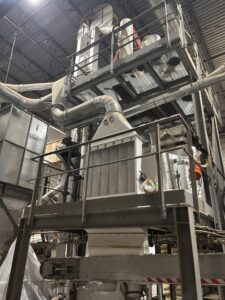
Industrial bulk material handling system featuring ductwork, mechanical equipment, steel support structure, and elevated service platforms inside a manufacturing facility.
A multi‑level bulk material handling setup showing integrated ducting, screening, and conveyance equipment designed for controlled material flow and safe plant operation.

Bulk material handling is a critical part of every industrial operation, ensuring materials like grain, aggregates, powders, pellets, and scrap move safely through a facility.  Well designed bulk material handling systems, such as conveyors, bins, hoppers, feeders, and dust control equipment directly influence productivity, safety, and overall plant performance.  When material flow is optimized, companies reduce downtime, prevent bottlenecks, and extend equipment life.  However, when systems are undersized, worn, or poorly designed, issues such as bridging, spillage, dust, and inconsistent throughput can quickly disrupt production.  This guide introduces the fundamentals of bulk material handling, explains how key equipment works, and highlights best practices that help industrial operations improve reliability and maximize material flow.

What is Bulk Material Handling and Why It Matters

Bulk material handling is the science and engineering of moving, storing, metering, and processing unpackaged materials like grains, pellets, powders, aggregates, and scrap at scale.  Done right, it reduces bottlenecks, spillage, dust, equipment wear, and unplanned downtime, while improving throughput, worker safety, and overall productivity.

Typical Use Cases
  • Receiving and unloading trucks/rail
  • Internal transfers between processing stages
  • Storage (bins and hoppers)
  • Metered feeding to dryers, mixers, mills, screens, or baggers
  • Load-out to bulk or packaged shipping

Know Your Material: Characteristics Drive Design

Every good system starts with the material’s properties.  These directly influence equipment selection, geometry, wear protection, and controls.

  • Particle size & shape: powders vs. pellets vs. granules vs. coarse aggregates
  • Bulk density: impacts horsepower and structural design
  • Flowability: free flowing vs. cohesive; prone to bridging, ratholing or segregation
  • Abrasiveness & corrosiveness: dictates liners, alloys, and maintenance intervals
  • Moisture & hygroscopicity: caking risk, need for aeration or drying
  • Temperature & combustibility: impacts dust control, explosion protection, and sealing

Core Equipment: The Workhorses of Bulk Handling

Mechanical Conveyance
  • Belt conveyors: high capacity, long runs, gentle on product; ideal for grains and aggregates
  • Screw conveyors: compact, enclosed; good for short runs and metering. It’s important to watch for wear with abrasive materials.
  • Drag/chain conveyors: enclosed, low dust, robust for cereals and pellets
  • Bucket elevators: vertical lifting at high capacities; careful attention to boot cleaning and belt tracking
  • Roller/chain conveyors (unit handling): for totes and pallets adjacent to bulk operations
Storage and Containment
  • Bins: design for mass flow when possible to minimize stagnation and spoilage
  • Hoppers: geometry (wall angle, outlet shape) determines flow; add flow aids if necessary
  • Domes/buildings: bulk storage for aggregates and salt; require reclaim strategies
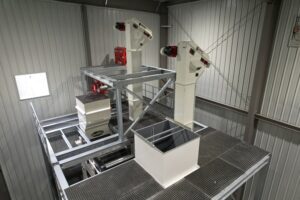
Indoor bulk material handling installation featuring twin bucket elevator heads, steel support structure, and elevated grated platforms inside a processing facility.
A clean, newly installed bucket elevator setup with dual discharge heads mounted on a reinforced steel platform, designed for efficient vertical conveying in industrial applications.
Feeding and Metering
  • Vibratory feeders: precise control for fragile or tricky materials
  • Rotary airlocks: maintain differential pressure in pneumatic systems while metering solids
  • Weight belts & loss-in-weight feeders: for recipe accuracy and process control
Conditioning and Processing
  • Dryers (ex. Grain dryers): moisture control for quality and storability
  • Screens/sifters: remove fines or overs
  • Crushers/mills/mixers: size reduction and blending. There is a need to consider wear parts and dust containment
Receiving and Load Out
  • Truck/rail receiving pits: designed for surge and dust capture
  • Spouts & chutes: telescoping or dust-tight spouts minimize spillage and emissions
  • Scale systems: truck scales, belt scales, hopper scales for custody transfer and QA.

Design Principles That Prevent Headaches

  • Design for flow: target mass flow in bins (steeper walls, smooth liners, proper outlet geometry) to reduce bridging and ratholing.
  • Right-size capacity: align conveying rates, storage volumes, and equipment runtimes to avoid bottlenecks and idle assets.
  • Protect against wear: use abrasion-resistant liners and replaceable wear components.
  • Control dust and spillage: enclosure, skirt boards, proper transitions, dust collection, and housekeeping plans.
  • Plan access and maintenance: guards, platforms, safe pull-cords, inspection doors, cleanouts, and hoisting points.
  • Integrate controls early: instrumentation and PLC logic should be designed with process sequences, interlocks, and safety functions from the outset.

Safety Essentials

  • Machine guarding and LOTO: guard pinch points and rotating parts; enforce lockout/tagout during maintenance.
  • Fall protection and confined spaces: safe access to bins, elevators, and pits; entry permits, rescue plans.
  • Combustible dust management: hazard assessment, housekeeping, dust collection, explosion protection (venting/suppression) where applicable.
  • Material hazards: corrosive or toxic dusts require appropriate PPE, containment, and monitoring.
  • Training and procedures: startup/shutdown checklists, emergency stop testing, and regular safety drills.
Industrial screw conveyor with motor and gearbox mounted on an elevated steel platform inside a bulk material handling facility.
A heavy‑duty screw conveyor with a motor and gearbox mounted on a grated service platform, designed for controlled material transfer within an industrial processing system.

Automation, Instrumentation and SCADA

Smart systems improve uptime, quality, and energy use:

  • Sensors: level (continuous and point), load cells, belt scales, flow meters, speed and vibration monitoring.
  • Controls: PLCs with interlock, permissives, and recipe management.
  • SCADA/HMI: real-time dashboards, alarms, trends, remote access.
  • Predictive maintenance: vibration/temperature analytics for bearings, drives, and bucket elevator belts.
  • Energy optimization: variable frequency drives (VFDs), demand control, and sequencing logic.

Common Problems and Practical Fixes

  • Bridging/ratholing: adjust hopper angles, increase outlet size, add flow aids (vibrators, air cannons, liners, bin activators).
  • Excessive wear: upgrade liners and flight materials; optimize speed and reduce unnecessary drops.
  • Dust/spillage: improve sealing, install dust collection at transfer points, revise chute geometry.
  • Misalignment & tracking: check pulley alignment, tensioning, and belt condition; use training idlers.
  • Corrosion and contamination: select compatible materials, add covers/enclosures, improve housekeeping.
  • Cold-weather issues: heat tracing, dehumidification, enclosure, and winter operating.

Best Practices for Throughput and Reliability

  • Holistic layouts: design transfers to minimize drops and sharp changes in direction.
  • Standardize components: reduce spare parts complexity and speed up repairs
  • Routine inspections: daily walk-arounds, weekly lubrication, monthly alignment checks.
  • Calibration cadence: scales, feeders, and sensors on a defined scheduled, with records.
  • Shutdown planning: planned maintenance windows with scope, parts kits, and pre-start functional tests.
  • Continuous improvement: log downtime events, perform root-cause analysis, and update SOPs.

When to Call a Specialist

Bring in experts when you’re:

  • Planning expansions or new lines.
  • Experiencing chronic flow problems or frequent wear failures.
  • Integrating automation or upgrading controls.
  • Implementing dust and explosion risk controls.
  • Scheduling annual shutdowns and maintenance packages

Contact Us

ACi Industrial logoACi supports end-to-end bulk handing, from design and fabrication to installation, controls, and planned maintenance.  If you’re facing throughput, safety, or reliability challenges, we can help diagnose, design, and implement improvements.  Contact a team member today by calling 519 759 5880 (Brantford Office), or 613 652 1010 (Brinston Office), email sales@aci-industrial.com, or fill out the contact form below.
Contact Us

Serving the agricultural, commercial, and industrial sectors, ACi delivers solid turnkey projects. Off-the-shelf or custom solutions? Backed by our team of Engineers our Millwrights, Electricians, and Metal Fabricators, have the experience to turn your business idea into reality.

Contact Us