bulk material handling, Engineering & Design, Industrial Systems

The Basics of Industrial Bulk Material Conveyance
ACi Industrial logo with green gear icon and the headline “The Basics of Conveyance in Industrial Bulk Material Handling
An overview of industrial bulk material conveyance systems, including common methods used to move materials efficiently and safely.

In industrial environments where bulk materials are constantly on the move, conveyance systems are the backbone of efficient operations.  Whether moving aggregates, grain, powders, pellets, or by-products, selecting the right conveying method can significantly impact productivity, safety, maintenance costs, and overall system reliability.

This article breaks down the fundamentals of industrial conveyance; what it is, why it matters, and the most common systems used in bulk material handling applications.

What Is Conveyance?

Conveyance refers to the controlled movement of bulk materials from one point to another within a facility or across a site.  In industrial bulk material handling, this typically involves mechanical systems designed to move large volumes of material efficiently, safely, and consistently.

A well-designed conveying system:

  • Reduces manual handling and labour requirements.
  • Improves throughput and process efficiency.
  • Minimizes material loss and product damage.
  • Enhances workplace safety and cleanliness.

Key Factors That Influence Conveying System Design

Before selecting a conveying solution, several variables must be considered:

1. Material Characteristics

Different materials behave very differently.  Key properties include:

  • Particle size and shape.
  • Bulk density.
  • Moisture content.
  • Flowability and abrasiveness

These characteristics directly affect system selection, wear points, and maintenance requirements.

2. Capacity and Throughput

The required tons or bushels per hour will influence:

  • Conveyor size and speed.
  • Drive power and motor selection.
  • Structural design and support requirements.

3. Distance and Elevation

Horizontal runs, inclines, and vertical lifts each demand different conveying technologies.  Elevation changes often introduce the greatest mechanical challenges.

4. Environmental Conditions

Outdoor exposure, dust control requirements, temperature extremes, and corrosion risks all play a role in system design and material selection.

Common Types of Industrial Conveyance Systems
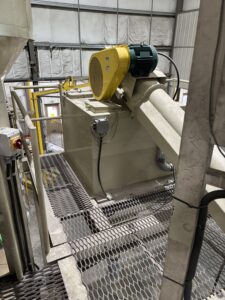
Industrial screw conveyor with motor and gearbox mounted on an elevated steel platform inside a bulk material handling facility.
A heavy‑duty screw conveyor with a motor and gearbox mounted on a grated service platform, designed for controlled material transfer within an industrial processing system.
Belt Conveyors

Belt conveyors are among the most widely used conveying systems in industrial applications.

Best suited for:

  • Long-distance transport.
  • High-capacity, continuous flow.
  • Gentle handling of materials.

Key advantages:

  • Energy efficient.
  • Low material degradation.
  • Flexible layout options.
Screw Conveyors (Augers)

Screw conveyors use a rotating helical flight to move material through a trough or tube.

Best suited for:

  • Short to medium distances.
  • Controlled feed applications.
  • Powders and fine materials.

Key advantages:

  • Compact design.
  • Enclosed for dust control.
  • Precise material metering.
Drag Conveyors

Drag conveyors move material using paddles or flights inside and enclosed casing.

Best suited for:

  • Abrasive or dusty materials.
  • Multiple inlet and discharge points.
  • Low-speed, controlled movement.

Key advantages:

  • Fully enclosed design.
  • Reduced dust emissions.
  • Minimal material degradation.
Bucket Elevators

Bucket elevators are designed for vertical conveying, lifting material using buckets attached to a belt or chain.

Best suited for:

  • Vertical lifts in limited floor space.
  • High-capacity applications.
  • Grain, aggregates, and industrial bulk products.

Key advantages:

  • Efficient vertical transport.
  • Small footprint.
  • High throughput capacity.

Why Proper Conveyance Matters

A poorly designed or outdated conveying system can create bottlenecks, increase downtime, and drive up maintenance costs.  Conversely, a properly engineered solution can:

  • Extend equipment life.
  • Improve system reliability.
  • Reduce operating costs.
  • Support future expansion.

At ACi, conveyance is never treated as a one-size-fits-all solution.  Every system is evaluated based on the material, process requirements, and long-term operational goals.

Partnering with ACi
ACi Industrial logoFrom concept and layout to fabrication, installation, and ongoing service, ACi delivers complete bulk material handling solutions.  Our team understand show conveyance integrates with structural steel, electrical systems, automation, and plant operations, ensuring each system performs as intended.

If you are planning a new installation, system upgrade, or capacity expansion, our team can help you design a conveying solution that works today and scales for tomorrow.  To contact one of our team members, call 519 759 5880 (Brantford Office), or 613 652 1010 (Brinston Office), email sales@aci-industrial.com, or fill out the contact form below.
bulk material handling, industrial automation, process optimization, smart technology, Uncategorized

Automation & Smart Technology in Bulk Material Handling: How Industrial Facilities are Boosting Efficiency in 2026

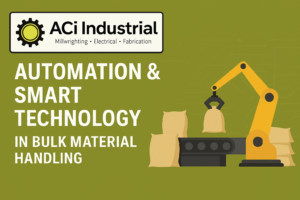
ACi Industrial graphic showing automation and smart technology in bulk material handling, featuring a robotic arm transferring bags on a conveyor.
Automation and smart technology solutions help industrial facilities improve efficiency, reduce downtime, and address labour challenges in bulk material handling operations.

Labour shortages, rising operating costs, and increasing production demands are pushing industrial facilities to rethink how they move, monitor, and manage bulk materials. Across Canada, plants are adopting automation and smart technologies to solve long-standing challenges, such as unplanned downtime, inconsistent throughput, and reliability issues caused by aging infrastructure.

As more facilities modernize, one trend is clear: automation isn’t a future investment anymore, it’s now a core part of efficient, safe, and scalable bulk material handling systems.

In this article, we explore the top automation technologies transforming industrial operations in 2026, and how they directly improve performance on the plant floor.

AGVs and AMRs: Transforming Material Movement Without Adding Labour

Automated Guided Vehicles (AGVs) and Autonomous Mobile Robots (AMRs) are becoming a key solution for facilities struggling with labour shortages or inconsistent availability of forklift operators.

What They Do
  • Move raw materials, finished goods, or bulk components between workstations.
  • Reduce reliance on manual transport.
  • Operate continuously with predictable cycle times.
Benefits to Material Handling
  • Smoother, more predictable throughput.
  • Reduced labour costs and operator fatigue.
  • Improved safety by removing manual forklift traffic from busy aisles.
  • Consistent flow, especially during peak periods or shift changes.

For facilities that frequently move totes, bins, super sacks, pallets, or bulk loads internally, AMRs and AGVs provide measurable efficiency gains with minimal disruption to existing layouts.

Predictive Maintenance: Stopping Failures Before They Shut You Down

Unplanned downtime remains one of the most expensive risks for bulk handling operations.  When a conveyor, feeder, or bucket elevator goes down, the entire production process slows down, or stops completely.

Predictive maintenance uses sensors, data models, and automated alerts to identify issues before a failure occurs.

What Predictive Maintenance Identifies
  • Bearing wear
  • Motor temperature anomalies.
  • Belt misalignment.
  • Vibration patterns that signal upcoming mechanical failures.
  • Gearbox deterioration.
Why Facilities Are Adopting It
  • Reduces downtime.
  • Lowers maintenance costs.
  • Eliminates guesswork from shutdown planning.
  • Extends the lifespan of equipment.

This technology is especially valuable for conveyors, which are typically the highest-maintenance, and highest-impact assets in any bulk handling system.

AI & Machine Learning: Smarter Decisions, Faster Corrections

AI-powered optimization helps plants maintain consistent flow rates and reduce bottlenecks.  Machine learning algorithms can analyze months of equipment and production data to recommend or automatically execute adjustments.

Where AI Creates Value
  • Optimizing conveyor speeds based on material flow.
  • Balancing feed rates to prevent overloading.
  • Detecting anomalies faster than manual monitoring.
  • Learning from historical trends to recommend settings.

For bulk material handling, where even small inconsistencies cause significant downstream issues, AI provides a layer of control that human operators can't sustain manually 24/7.

IoT Sensors: Real-Time Visibility for Flow, Moisture, Temperature and More

IoT sensors give operators the ability to monitor each stage of material movement, from storage to discharge to conveying, in real time.

Common Sensor Applications
  • Flow monitoring: Detects bridging, ratholing, or slow discharge from silos.
  • Moisture sensing: Critical for grain, powders, fertilizers, and aggregates.
  • Temperature sensing: Helps prevent overheating in motors and bearings.
  • Vibration sensing: Early detection of mechanical issues.
  • Level monitoring: Accurate inventory data for silos and bins.
The Result
  • Less manual inspection.
  • Faster response to flow issues.
  • Better planning for production and purchasing.
  • Increased safety through earlier detection of system failures.

Automated Bagging & Palletizing: Increasing Throughput and Reducing Manual Labour

Packaging is one of the biggest bottlenecks for manufacturers and processors.  Automated bagging and palletizing systems eliminate repetitive strain tasks and keep packaging output consistent, even when labour is limited.

Automation Capabilities
  • Bag filling.
  • Weighing.
  • Sealing.
  • Labeling.
  • Robotic palletizing.
Why Plants Are Upgrading
  • Often faster than manual labour.
  • Improved accuracy and weight control.
  • Fewer injuries from repetitive lifting.
  • Continuous output, even during shift gaps.

For facilities handling grain, fertilizer, food ingredients, plastics, minerals, or chemicals, automated packaging lines offer one of the quickest ROI paths in the automation category.

Bringing It All Together: A Smarter, Safer, More Efficient Operation

When combined, these technologies create an ecosystem where:

  • Material flow is predictable.
  • Equipment performance is monitored continuously.
  • Throughput is optimized automatically.
  • Labour requirements are reduced.
  • Safety risks are minimized.

ACi helps facilities integrated automation into existing bulk material handling systems without disrupting production.  From conveyors and storage to sensing, data, and controls, we provide engineered solutions that reduce downtime and deliver consistent and measurable performance.

Contact Us

ACi Industrial logoTo learn more and discuss how we can help your business operations, contact one of our team members today by calling 519 759 5880 (Brantford Office), or 613 652 1010 (Brinston Office), email sales@aci-industrial.com, or fill out the contact form below.
Contact Us

automation and technology, bulk material handling, equipment solutions, industrial safety, Operational Efficiency, safety and operations, Uncategorized

Bulk Material Handling 101: The Essential Guide for Industrial Operations


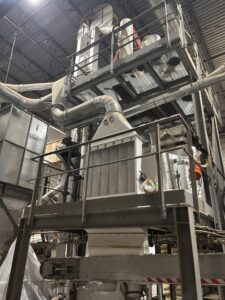
Industrial bulk material handling system featuring ductwork, mechanical equipment, steel support structure, and elevated service platforms inside a manufacturing facility.
A multi‑level bulk material handling setup showing integrated ducting, screening, and conveyance equipment designed for controlled material flow and safe plant operation.

Bulk material handling is a critical part of every industrial operation, ensuring materials like grain, aggregates, powders, pellets, and scrap move safely through a facility.  Well designed bulk material handling systems, such as conveyors, bins, hoppers, feeders, and dust control equipment directly influence productivity, safety, and overall plant performance.  When material flow is optimized, companies reduce downtime, prevent bottlenecks, and extend equipment life.  However, when systems are undersized, worn, or poorly designed, issues such as bridging, spillage, dust, and inconsistent throughput can quickly disrupt production.  This guide introduces the fundamentals of bulk material handling, explains how key equipment works, and highlights best practices that help industrial operations improve reliability and maximize material flow.

What is Bulk Material Handling and Why It Matters

Bulk material handling is the science and engineering of moving, storing, metering, and processing unpackaged materials like grains, pellets, powders, aggregates, and scrap at scale.  Done right, it reduces bottlenecks, spillage, dust, equipment wear, and unplanned downtime, while improving throughput, worker safety, and overall productivity.

Typical Use Cases
  • Receiving and unloading trucks/rail
  • Internal transfers between processing stages
  • Storage (bins and hoppers)
  • Metered feeding to dryers, mixers, mills, screens, or baggers
  • Load-out to bulk or packaged shipping

Know Your Material: Characteristics Drive Design

Every good system starts with the material’s properties.  These directly influence equipment selection, geometry, wear protection, and controls.

  • Particle size & shape: powders vs. pellets vs. granules vs. coarse aggregates
  • Bulk density: impacts horsepower and structural design
  • Flowability: free flowing vs. cohesive; prone to bridging, ratholing or segregation
  • Abrasiveness & corrosiveness: dictates liners, alloys, and maintenance intervals
  • Moisture & hygroscopicity: caking risk, need for aeration or drying
  • Temperature & combustibility: impacts dust control, explosion protection, and sealing

Core Equipment: The Workhorses of Bulk Handling

Mechanical Conveyance
  • Belt conveyors: high capacity, long runs, gentle on product; ideal for grains and aggregates
  • Screw conveyors: compact, enclosed; good for short runs and metering. It’s important to watch for wear with abrasive materials.
  • Drag/chain conveyors: enclosed, low dust, robust for cereals and pellets
  • Bucket elevators: vertical lifting at high capacities; careful attention to boot cleaning and belt tracking
  • Roller/chain conveyors (unit handling): for totes and pallets adjacent to bulk operations
Storage and Containment
  • Bins: design for mass flow when possible to minimize stagnation and spoilage
  • Hoppers: geometry (wall angle, outlet shape) determines flow; add flow aids if necessary
  • Domes/buildings: bulk storage for aggregates and salt; require reclaim strategies
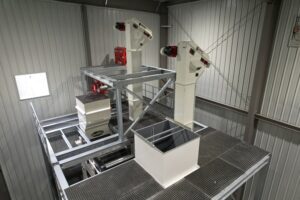
Indoor bulk material handling installation featuring twin bucket elevator heads, steel support structure, and elevated grated platforms inside a processing facility.
A clean, newly installed bucket elevator setup with dual discharge heads mounted on a reinforced steel platform, designed for efficient vertical conveying in industrial applications.
Feeding and Metering
  • Vibratory feeders: precise control for fragile or tricky materials
  • Rotary airlocks: maintain differential pressure in pneumatic systems while metering solids
  • Weight belts & loss-in-weight feeders: for recipe accuracy and process control
Conditioning and Processing
  • Dryers (ex. Grain dryers): moisture control for quality and storability
  • Screens/sifters: remove fines or overs
  • Crushers/mills/mixers: size reduction and blending. There is a need to consider wear parts and dust containment
Receiving and Load Out
  • Truck/rail receiving pits: designed for surge and dust capture
  • Spouts & chutes: telescoping or dust-tight spouts minimize spillage and emissions
  • Scale systems: truck scales, belt scales, hopper scales for custody transfer and QA.

Design Principles That Prevent Headaches

  • Design for flow: target mass flow in bins (steeper walls, smooth liners, proper outlet geometry) to reduce bridging and ratholing.
  • Right-size capacity: align conveying rates, storage volumes, and equipment runtimes to avoid bottlenecks and idle assets.
  • Protect against wear: use abrasion-resistant liners and replaceable wear components.
  • Control dust and spillage: enclosure, skirt boards, proper transitions, dust collection, and housekeeping plans.
  • Plan access and maintenance: guards, platforms, safe pull-cords, inspection doors, cleanouts, and hoisting points.
  • Integrate controls early: instrumentation and PLC logic should be designed with process sequences, interlocks, and safety functions from the outset.

Safety Essentials

  • Machine guarding and LOTO: guard pinch points and rotating parts; enforce lockout/tagout during maintenance.
  • Fall protection and confined spaces: safe access to bins, elevators, and pits; entry permits, rescue plans.
  • Combustible dust management: hazard assessment, housekeeping, dust collection, explosion protection (venting/suppression) where applicable.
  • Material hazards: corrosive or toxic dusts require appropriate PPE, containment, and monitoring.
  • Training and procedures: startup/shutdown checklists, emergency stop testing, and regular safety drills.
Industrial screw conveyor with motor and gearbox mounted on an elevated steel platform inside a bulk material handling facility.
A heavy‑duty screw conveyor with a motor and gearbox mounted on a grated service platform, designed for controlled material transfer within an industrial processing system.

Automation, Instrumentation and SCADA

Smart systems improve uptime, quality, and energy use:

  • Sensors: level (continuous and point), load cells, belt scales, flow meters, speed and vibration monitoring.
  • Controls: PLCs with interlock, permissives, and recipe management.
  • SCADA/HMI: real-time dashboards, alarms, trends, remote access.
  • Predictive maintenance: vibration/temperature analytics for bearings, drives, and bucket elevator belts.
  • Energy optimization: variable frequency drives (VFDs), demand control, and sequencing logic.

Common Problems and Practical Fixes

  • Bridging/ratholing: adjust hopper angles, increase outlet size, add flow aids (vibrators, air cannons, liners, bin activators).
  • Excessive wear: upgrade liners and flight materials; optimize speed and reduce unnecessary drops.
  • Dust/spillage: improve sealing, install dust collection at transfer points, revise chute geometry.
  • Misalignment & tracking: check pulley alignment, tensioning, and belt condition; use training idlers.
  • Corrosion and contamination: select compatible materials, add covers/enclosures, improve housekeeping.
  • Cold-weather issues: heat tracing, dehumidification, enclosure, and winter operating.

Best Practices for Throughput and Reliability

  • Holistic layouts: design transfers to minimize drops and sharp changes in direction.
  • Standardize components: reduce spare parts complexity and speed up repairs
  • Routine inspections: daily walk-arounds, weekly lubrication, monthly alignment checks.
  • Calibration cadence: scales, feeders, and sensors on a defined scheduled, with records.
  • Shutdown planning: planned maintenance windows with scope, parts kits, and pre-start functional tests.
  • Continuous improvement: log downtime events, perform root-cause analysis, and update SOPs.

When to Call a Specialist

Bring in experts when you’re:

  • Planning expansions or new lines.
  • Experiencing chronic flow problems or frequent wear failures.
  • Integrating automation or upgrading controls.
  • Implementing dust and explosion risk controls.
  • Scheduling annual shutdowns and maintenance packages

Contact Us

ACi Industrial logoACi supports end-to-end bulk handing, from design and fabrication to installation, controls, and planned maintenance.  If you’re facing throughput, safety, or reliability challenges, we can help diagnose, design, and implement improvements.  Contact a team member today by calling 519 759 5880 (Brantford Office), or 613 652 1010 (Brinston Office), email sales@aci-industrial.com, or fill out the contact form below.
Contact Us

automation and technology, industrial construction, Industry Trends, safety and operations, sustainability and compliance

Top 5 Industrial Trends to Watch in 2026

The industrial sector is evolving rapidly, driven by technology, sustainability goals, and the need for safer, more efficient operations.  Understanding these trends can help businesses prepare for the future, even if you're not ready to make changes today.  Here are five key developments shaping 2026.

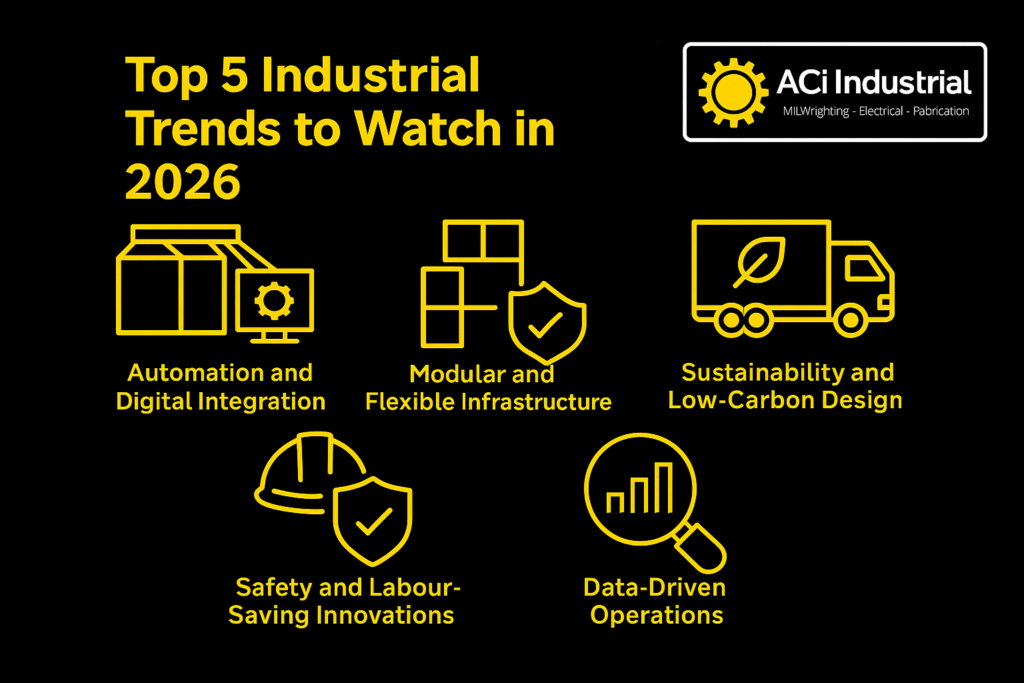
Branded ACi Industrial graphic showing the top five industrial trends for 2026, including automation, modular infrastructure, sustainability, safety innovations, and data-driven operations, with icons and ACi’s logo in ACi colours.
A visual overview of the five industrial trends shaping 2026: automation, modular infrastructure, sustainability, safety-focused design, and data-driven operations—presented in ACi Industrial’s colours and branding.

Automation and Digital Integration

Automation is no longer limited to high-tech plants.  Across industries, facilities are adopting advanced control systems and remote monitoring to improve efficiency and reduce downtime.  Digital integration allows operators to manage processes from centralized control rooms or mobile devices, creating faster response times and better visibility.

Modular and Flexible Infrastructure

Speed and adaptability are becoming essential.  Modular steel structures and prefabricated components are gaining popularity because they reduce on-site construction time and allow facilities to scale up or reconfigure as needs change.  This flexibility is especially valuable in sectors facing fluctuating demand or seasonal operations.

Sustainability and Low-Carbon Design

Environmental regulations and corporate responsibility initiatives are pushing companies toward greener practices.  Energy-efficient systems, optimized layouts, and sustainable materials are becoming standard considerations in industrial projects.  Logistics strategies are also evolving to reduce emissions and meet compliance requirements.

Safety and Labour-Saving Innovations

Worker safety remains a top priority.  Expect more emphasis on designs that minimize manual intervention, improve ergonomics, and reduce exposure to hazards like dust or confined spaces.  Automation and modular systems are playing a big role in reducing labour-intensive tasks and improving overall safety.

Data-Driven Operations

The rise of IoT sensors and predictive analytics is transforming maintenance and material handling.  Real-time data helps anticipate equipment failures, optimize storage, and improve decision-making.  This shift toward data-driven operations is enabling businesses to reduce downtime and improve efficiency without major overhauls.

Why These Trends Matter

These developments aren't just for large corporations, they're shaping best practices across the industrial and agribusiness landscape.  Staying informed can help you identify opportunities to improve safety, efficiency, and sustainability in your own operations.

Contact Us

ACi Industrial logoWant to learn more and discuss how these trends may impact your business operations?  Contact one of our team members today by calling 519 759 5880 (Brantford Office), or 613 652 1010 (Brinston Office), email sales@aci-industrial.com, or fill out the contact form below.

Contact Us

Serving the agricultural, commercial, and industrial sectors, ACi delivers solid turnkey projects. Off-the-shelf or custom solutions? Backed by our team of Engineers our Millwrights, Electricians, and Metal Fabricators, have the experience to turn your business idea into reality.

Contact Us