bulk material handling, Engineering & Design, Industrial Systems

The Basics of Industrial Bulk Material Conveyance
ACi Industrial logo with green gear icon and the headline “The Basics of Conveyance in Industrial Bulk Material Handling
An overview of industrial bulk material conveyance systems, including common methods used to move materials efficiently and safely.

In industrial environments where bulk materials are constantly on the move, conveyance systems are the backbone of efficient operations.  Whether moving aggregates, grain, powders, pellets, or by-products, selecting the right conveying method can significantly impact productivity, safety, maintenance costs, and overall system reliability.

This article breaks down the fundamentals of industrial conveyance; what it is, why it matters, and the most common systems used in bulk material handling applications.

What Is Conveyance?

Conveyance refers to the controlled movement of bulk materials from one point to another within a facility or across a site.  In industrial bulk material handling, this typically involves mechanical systems designed to move large volumes of material efficiently, safely, and consistently.

A well-designed conveying system:

  • Reduces manual handling and labour requirements.
  • Improves throughput and process efficiency.
  • Minimizes material loss and product damage.
  • Enhances workplace safety and cleanliness.

Key Factors That Influence Conveying System Design

Before selecting a conveying solution, several variables must be considered:

1. Material Characteristics

Different materials behave very differently.  Key properties include:

  • Particle size and shape.
  • Bulk density.
  • Moisture content.
  • Flowability and abrasiveness

These characteristics directly affect system selection, wear points, and maintenance requirements.

2. Capacity and Throughput

The required tons or bushels per hour will influence:

  • Conveyor size and speed.
  • Drive power and motor selection.
  • Structural design and support requirements.

3. Distance and Elevation

Horizontal runs, inclines, and vertical lifts each demand different conveying technologies.  Elevation changes often introduce the greatest mechanical challenges.

4. Environmental Conditions

Outdoor exposure, dust control requirements, temperature extremes, and corrosion risks all play a role in system design and material selection.

Common Types of Industrial Conveyance Systems
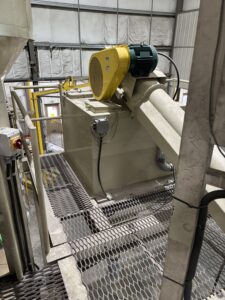
Industrial screw conveyor with motor and gearbox mounted on an elevated steel platform inside a bulk material handling facility.
A heavy‑duty screw conveyor with a motor and gearbox mounted on a grated service platform, designed for controlled material transfer within an industrial processing system.
Belt Conveyors

Belt conveyors are among the most widely used conveying systems in industrial applications.

Best suited for:

  • Long-distance transport.
  • High-capacity, continuous flow.
  • Gentle handling of materials.

Key advantages:

  • Energy efficient.
  • Low material degradation.
  • Flexible layout options.
Screw Conveyors (Augers)

Screw conveyors use a rotating helical flight to move material through a trough or tube.

Best suited for:

  • Short to medium distances.
  • Controlled feed applications.
  • Powders and fine materials.

Key advantages:

  • Compact design.
  • Enclosed for dust control.
  • Precise material metering.
Drag Conveyors

Drag conveyors move material using paddles or flights inside and enclosed casing.

Best suited for:

  • Abrasive or dusty materials.
  • Multiple inlet and discharge points.
  • Low-speed, controlled movement.

Key advantages:

  • Fully enclosed design.
  • Reduced dust emissions.
  • Minimal material degradation.
Bucket Elevators

Bucket elevators are designed for vertical conveying, lifting material using buckets attached to a belt or chain.

Best suited for:

  • Vertical lifts in limited floor space.
  • High-capacity applications.
  • Grain, aggregates, and industrial bulk products.

Key advantages:

  • Efficient vertical transport.
  • Small footprint.
  • High throughput capacity.

Why Proper Conveyance Matters

A poorly designed or outdated conveying system can create bottlenecks, increase downtime, and drive up maintenance costs.  Conversely, a properly engineered solution can:

  • Extend equipment life.
  • Improve system reliability.
  • Reduce operating costs.
  • Support future expansion.

At ACi, conveyance is never treated as a one-size-fits-all solution.  Every system is evaluated based on the material, process requirements, and long-term operational goals.

Partnering with ACi
ACi Industrial logoFrom concept and layout to fabrication, installation, and ongoing service, ACi delivers complete bulk material handling solutions.  Our team understand show conveyance integrates with structural steel, electrical systems, automation, and plant operations, ensuring each system performs as intended.

If you are planning a new installation, system upgrade, or capacity expansion, our team can help you design a conveying solution that works today and scales for tomorrow.  To contact one of our team members, call 519 759 5880 (Brantford Office), or 613 652 1010 (Brinston Office), email sales@aci-industrial.com, or fill out the contact form below.
bulk material handling, industrial automation, process optimization, smart technology, Uncategorized

Automation & Smart Technology in Bulk Material Handling: How Industrial Facilities are Boosting Efficiency in 2026

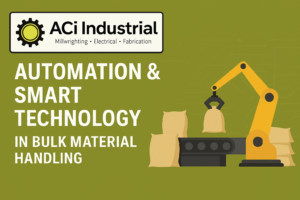
ACi Industrial graphic showing automation and smart technology in bulk material handling, featuring a robotic arm transferring bags on a conveyor.
Automation and smart technology solutions help industrial facilities improve efficiency, reduce downtime, and address labour challenges in bulk material handling operations.

Labour shortages, rising operating costs, and increasing production demands are pushing industrial facilities to rethink how they move, monitor, and manage bulk materials. Across Canada, plants are adopting automation and smart technologies to solve long-standing challenges, such as unplanned downtime, inconsistent throughput, and reliability issues caused by aging infrastructure.

As more facilities modernize, one trend is clear: automation isn’t a future investment anymore, it’s now a core part of efficient, safe, and scalable bulk material handling systems.

In this article, we explore the top automation technologies transforming industrial operations in 2026, and how they directly improve performance on the plant floor.

AGVs and AMRs: Transforming Material Movement Without Adding Labour

Automated Guided Vehicles (AGVs) and Autonomous Mobile Robots (AMRs) are becoming a key solution for facilities struggling with labour shortages or inconsistent availability of forklift operators.

What They Do
  • Move raw materials, finished goods, or bulk components between workstations.
  • Reduce reliance on manual transport.
  • Operate continuously with predictable cycle times.
Benefits to Material Handling
  • Smoother, more predictable throughput.
  • Reduced labour costs and operator fatigue.
  • Improved safety by removing manual forklift traffic from busy aisles.
  • Consistent flow, especially during peak periods or shift changes.

For facilities that frequently move totes, bins, super sacks, pallets, or bulk loads internally, AMRs and AGVs provide measurable efficiency gains with minimal disruption to existing layouts.

Predictive Maintenance: Stopping Failures Before They Shut You Down

Unplanned downtime remains one of the most expensive risks for bulk handling operations.  When a conveyor, feeder, or bucket elevator goes down, the entire production process slows down, or stops completely.

Predictive maintenance uses sensors, data models, and automated alerts to identify issues before a failure occurs.

What Predictive Maintenance Identifies
  • Bearing wear
  • Motor temperature anomalies.
  • Belt misalignment.
  • Vibration patterns that signal upcoming mechanical failures.
  • Gearbox deterioration.
Why Facilities Are Adopting It
  • Reduces downtime.
  • Lowers maintenance costs.
  • Eliminates guesswork from shutdown planning.
  • Extends the lifespan of equipment.

This technology is especially valuable for conveyors, which are typically the highest-maintenance, and highest-impact assets in any bulk handling system.

AI & Machine Learning: Smarter Decisions, Faster Corrections

AI-powered optimization helps plants maintain consistent flow rates and reduce bottlenecks.  Machine learning algorithms can analyze months of equipment and production data to recommend or automatically execute adjustments.

Where AI Creates Value
  • Optimizing conveyor speeds based on material flow.
  • Balancing feed rates to prevent overloading.
  • Detecting anomalies faster than manual monitoring.
  • Learning from historical trends to recommend settings.

For bulk material handling, where even small inconsistencies cause significant downstream issues, AI provides a layer of control that human operators can't sustain manually 24/7.

IoT Sensors: Real-Time Visibility for Flow, Moisture, Temperature and More

IoT sensors give operators the ability to monitor each stage of material movement, from storage to discharge to conveying, in real time.

Common Sensor Applications
  • Flow monitoring: Detects bridging, ratholing, or slow discharge from silos.
  • Moisture sensing: Critical for grain, powders, fertilizers, and aggregates.
  • Temperature sensing: Helps prevent overheating in motors and bearings.
  • Vibration sensing: Early detection of mechanical issues.
  • Level monitoring: Accurate inventory data for silos and bins.
The Result
  • Less manual inspection.
  • Faster response to flow issues.
  • Better planning for production and purchasing.
  • Increased safety through earlier detection of system failures.

Automated Bagging & Palletizing: Increasing Throughput and Reducing Manual Labour

Packaging is one of the biggest bottlenecks for manufacturers and processors.  Automated bagging and palletizing systems eliminate repetitive strain tasks and keep packaging output consistent, even when labour is limited.

Automation Capabilities
  • Bag filling.
  • Weighing.
  • Sealing.
  • Labeling.
  • Robotic palletizing.
Why Plants Are Upgrading
  • Often faster than manual labour.
  • Improved accuracy and weight control.
  • Fewer injuries from repetitive lifting.
  • Continuous output, even during shift gaps.

For facilities handling grain, fertilizer, food ingredients, plastics, minerals, or chemicals, automated packaging lines offer one of the quickest ROI paths in the automation category.

Bringing It All Together: A Smarter, Safer, More Efficient Operation

When combined, these technologies create an ecosystem where:

  • Material flow is predictable.
  • Equipment performance is monitored continuously.
  • Throughput is optimized automatically.
  • Labour requirements are reduced.
  • Safety risks are minimized.

ACi helps facilities integrated automation into existing bulk material handling systems without disrupting production.  From conveyors and storage to sensing, data, and controls, we provide engineered solutions that reduce downtime and deliver consistent and measurable performance.

Contact Us

ACi Industrial logoTo learn more and discuss how we can help your business operations, contact one of our team members today by calling 519 759 5880 (Brantford Office), or 613 652 1010 (Brinston Office), email sales@aci-industrial.com, or fill out the contact form below.

Contact Us

automation and technology, facility planning & execution, industrial construction, Industry Trends, Uncategorized

Turning Insight In to Action: How to Finalize Your Facility Strategy

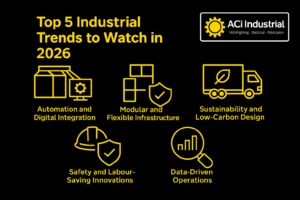
Branded ACi Industrial graphic showing the top five industrial trends for 2026, including automation, modular infrastructure, sustainability, safety innovations, and data-driven operations, with icons and ACi’s logo in ACi colours.
A visual overview of the five industrial trends shaping 2026: automation, modular infrastructure, sustainability, safety-focused design, and data-driven operations—presented in ACi Industrial’s colours and branding.

This article builds on our earlier review of the Top Industrial Trends for 2026 and the follow-up consideration-stage guide on how those trends influence facility planning.  If you’ve reached the point of evaluating your options and preparing for an investment, this decision-stage version is designed for you.

Industrial organizations across Ontario and beyond are now moving from research to action.  The trends driving change in 2026: automation, modular construction, sustainability, safety innovation, and data-driven operations are no longer theoretical.  They influence how projects are scoped, what technology is selected, how timelines are structured, and which partners are most capable of delivering.

Below is a clear, decision-oriented breakdown of what companies should finalize as they prepare to move forward with upgrades, expansions, or new builds.

1. Automation & Digital Integration: Final Decisions to Make

Automation is no longer simply a competitive advantage, it’s an operational requirement.  At this stage, organizations are determining which systems to integrate, how they will connect, and which vendor can ensure reliability and support. 

Key decisions now include:
  • Defining your controls architecture: PLC/SCADA standardization, communication protocols, and expansion capacity.
  • Selecting equipment that supports data and automation rather than locking you into outdated or standalone systems.
  • Confirming remote monitoring and cybersecurity requirements for your IT/OT environment.
  • Finalizing fail-safe logic and E-stop integration to meet compliance.

At this stag, the question is no longer “Should we automate?” but “Who will implement it, and how do we future-proof it?”

2. Modular & Flexible Infrastructure: Aligning Design With Schedule & Budget

Modular and prefabrication approaches reduce downtime and construction risk, but each project requires choosing the right balance of prefab vs. site-built elements.

Decision-stage considerations:
  • Confirming whether modular assemblies will reduce shutdown time enough to justify their use.
  • Finalizing structural standards (steel gauge, coatings, load ratings, accessibility requirements).
  • Coordinating modular components with civil, mechanical, and electrical scopes.
  • Locking in realistic installation timelines that align with production seasons or turnaround windows.

This is the moment where conceptual layouts become construction-ready designs.

3. Sustainability & Low-Carbon Design: Selecting the Right Tactics

Most organizations now face clear emissions, reporting, or energy-efficiency expectations.  Decision-makers are choosing which sustainability measures to implement and which to hold for future phases.

Common decisions at this stage:
  • Whether to adopt energy-efficient fans, motors, lighting, or HVAC as part of the upgrade.
  • Whether a site layout redesign can genuinely reduce internal traffic and fuel use.
  • Selecting materials and building standards that support long-term sustainability metrics.
  • Choosing systems that allow emissions data and energy use to be measured automatically.

Instead of exploring possibilities, this phase focuses on finalizing the strategies that align with your KPIs and compliance needs.

4. Safety & Labour-Saving Innovations: Engineering Out Risk

By the decision stage, most organizations have already assessed their high-risk areas.  Now they must finalize which engineered controls and design choices will mitigate those risks.

Critical decisions include:
  • Determining which elevated work areas require permanent access (stairs, platforms, catwalks).
  • Finalizing guarding, dust control, and explosion mitigation systems.
  • Selecting modular solutions that reduce construction time and limit worker exposure.
  • Choosing workflow-driven interior fit-ups that reduce bottlenecks and improve throughput.

This is where safety moves from “planning” to implementation and verification.

5. Data-Driven Operations: Confirming the Digital Roadmap

At this stage, organizations have typically identified where data will create value.  Now they must finalize their system architecture and technology stack.

Decision-phase checkpoints:
  • Selecting the sensors, monitoring tools, and reporting platforms that best fit your operation.
  • Confirming the data flow from equipment ->controls ->dashboards -> reporting
  • Establishing maintenance and reliability metrics MTBF, MTTR, condition-based triggers).
  • Ensuring scalability so future equipment integrates seamlessly.

This is where digital transformation becomes a defined, deliverable scope and not just a concept.

Bringing It All Together: Your 2026 Project Roadmap

If you’ve reached the decision stage, you’ve likely completed:

  • Understanding the trends.
  • Evaluating what matters to your facility.
  • Outlining your goals and internal requirements.

Now your focus shifts to:

  • Selecting the right partner(s).
  • Finalizing project scope, timeline, and budget.
  • Confirming standards, drawings, and specifications.
  • Planning site preparation and construction sequencing.
  • Booking fabrication, long-lead items, and installation windows.

This is where projects move from planning to execution.

Contact Us

ACi Industrial logoWant to learn more and discuss how to implement these trends in your business operations?  Contact one of our team members today by calling 519 759 5880 (Brantford Office), or 613 652 1010 (Brinston Office), email sales@aci-industrial.com, or fill out the contact form below.


Contact Us

Serving the agricultural, commercial, and industrial sectors, ACi delivers solid turnkey projects. Off-the-shelf or custom solutions? Backed by our team of Engineers our Millwrights, Electricians, and Metal Fabricators, have the experience to turn your business idea into reality.

Contact Us