
Automation & Smart Technology in Bulk Material Handling: How Industrial Facilities are Boosting Efficiency in 2026
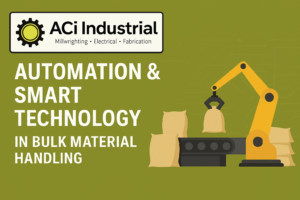
Labour shortages, rising operating costs, and increasing production demands are pushing industrial facilities to rethink how they move, monitor, and manage bulk materials. Across Canada, plants are adopting automation and smart technologies to solve long-standing challenges, such as unplanned downtime, inconsistent throughput, and reliability issues caused by aging infrastructure.
As more facilities modernize, one trend is clear: automation isn’t a future investment anymore, it’s now a core part of efficient, safe, and scalable bulk material handling systems.
In this article, we explore the top automation technologies transforming industrial operations in 2026, and how they directly improve performance on the plant floor.
AGVs and AMRs: Transforming Material Movement Without Adding Labour
Automated Guided Vehicles (AGVs) and Autonomous Mobile Robots (AMRs) are becoming a key solution for facilities struggling with labour shortages or inconsistent availability of forklift operators.
What They Do
- Move raw materials, finished goods, or bulk components between workstations.
- Reduce reliance on manual transport.
- Operate continuously with predictable cycle times.
Benefits to Material Handling
- Smoother, more predictable throughput.
- Reduced labour costs and operator fatigue.
- Improved safety by removing manual forklift traffic from busy aisles.
- Consistent flow, especially during peak periods or shift changes.
For facilities that frequently move totes, bins, super sacks, pallets, or bulk loads internally, AMRs and AGVs provide measurable efficiency gains with minimal disruption to existing layouts.
Predictive Maintenance: Stopping Failures Before They Shut You Down
Unplanned downtime remains one of the most expensive risks for bulk handling operations. When a conveyor, feeder, or bucket elevator goes down, the entire production process slows down, or stops completely.
Predictive maintenance uses sensors, data models, and automated alerts to identify issues before a failure occurs.
What Predictive Maintenance Identifies
- Bearing wear
- Motor temperature anomalies.
- Belt misalignment.
- Vibration patterns that signal upcoming mechanical failures.
- Gearbox deterioration.
Why Facilities Are Adopting It
- Reduces downtime.
- Lowers maintenance costs.
- Eliminates guesswork from shutdown planning.
- Extends the lifespan of equipment.
This technology is especially valuable for conveyors, which are typically the highest-maintenance, and highest-impact assets in any bulk handling system.
AI & Machine Learning: Smarter Decisions, Faster Corrections
AI-powered optimization helps plants maintain consistent flow rates and reduce bottlenecks. Machine learning algorithms can analyze months of equipment and production data to recommend or automatically execute adjustments.
Where AI Creates Value
- Optimizing conveyor speeds based on material flow.
- Balancing feed rates to prevent overloading.
- Detecting anomalies faster than manual monitoring.
- Learning from historical trends to recommend settings.
For bulk material handling, where even small inconsistencies cause significant downstream issues, AI provides a layer of control that human operators can't sustain manually 24/7.
IoT Sensors: Real-Time Visibility for Flow, Moisture, Temperature and More
IoT sensors give operators the ability to monitor each stage of material movement, from storage to discharge to conveying, in real time.
Common Sensor Applications
- Flow monitoring: Detects bridging, ratholing, or slow discharge from silos.
- Moisture sensing: Critical for grain, powders, fertilizers, and aggregates.
- Temperature sensing: Helps prevent overheating in motors and bearings.
- Vibration sensing: Early detection of mechanical issues.
- Level monitoring: Accurate inventory data for silos and bins.
The Result
- Less manual inspection.
- Faster response to flow issues.
- Better planning for production and purchasing.
- Increased safety through earlier detection of system failures.
Automated Bagging & Palletizing: Increasing Throughput and Reducing Manual Labour
Packaging is one of the biggest bottlenecks for manufacturers and processors. Automated bagging and palletizing systems eliminate repetitive strain tasks and keep packaging output consistent, even when labour is limited.
Automation Capabilities
- Bag filling.
- Weighing.
- Sealing.
- Labeling.
- Robotic palletizing.
Why Plants Are Upgrading
- Often faster than manual labour.
- Improved accuracy and weight control.
- Fewer injuries from repetitive lifting.
- Continuous output, even during shift gaps.
For facilities handling grain, fertilizer, food ingredients, plastics, minerals, or chemicals, automated packaging lines offer one of the quickest ROI paths in the automation category.
Bringing It All Together: A Smarter, Safer, More Efficient Operation
When combined, these technologies create an ecosystem where:
- Material flow is predictable.
- Equipment performance is monitored continuously.
- Throughput is optimized automatically.
- Labour requirements are reduced.
- Safety risks are minimized.
ACi helps facilities integrated automation into existing bulk material handling systems without disrupting production. From conveyors and storage to sensing, data, and controls, we provide engineered solutions that reduce downtime and deliver consistent and measurable performance.
Contact Us
 To learn more and discuss how we can help your business operations, contact one of our team members today by calling 519 759 5880 (Brantford Office), or 613 652 1010 (Brinston Office), email sales@aci-industrial.com, or fill out the contact form below.