Agricultural Technology and Innovation, facility planning & modernization, Grain Handling Solutions, Industry Trends, Uncategorized

From Awareness to Action: How 2026 Grain Handling Trends Impact Facility Planning
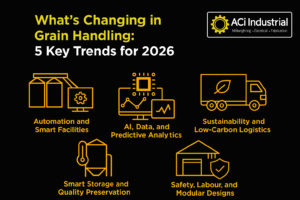
Illustration showing five key grain handling trends for 2026: automation and smart facilities, AI and predictive analytics, sustainability and low-carbon logistics, smart storage and quality preservation, and safety with modular designs.
Five major trends shaping grain handling in 2026: automation, AI-driven analytics, sustainability, smart storage, and safety-focused modular designs.

In our earlier post: What's Changing in Grain Handling and Why It Matters in 2026, we introduced the major forces reshaping grain handling this year.  As we move further into the year, we take this a step further to think about how these trends may apply to your site, your equipment, and your future planning.  This article focuses on the practical questions that grain elevators, terminals, and large farms are now asking as they evaluate modernization options for 2026 and beyond.

Automation & Smart Facilities: What Should You Evaluate?

Automation has shifted from a "nice-to-have" to a foundation of modern grain handling.  But the key question for many facilities is: Where should automation begin and how much integration is actually required?

Consideration Factors:
  • System fragmentation: Are receiving, conveying, drying, and loadout controlled separately?
  • Remote visibility: Would centralized dashboards or remote monitoring reduce manual checks or improve response times?
  • Scalability: Can your current PLC/SCADA setup support future expansions or added process areas?
  • Labour impact: Which tasks could automation safely eliminate or streamline?

Thinking through these questions helps narrow which automation upgrades will deliver the most meaningful ROI.

AI, Data & Predictive Analytics: Are You Data Ready?

AI and predictive analytics continue to expand in grain handling, but successful adoption depends on how well your facility already collects and organizes data.

What to Consider:
  • Sensor coverage: Which equipment (legs, belts, dryers, fans) lacks monitoring or trend data?
  • Data quality: Are current readings accurate, continuous, and accessible?
  • Integration needs: Will your existing controls feed data into an analytics platform?
  • Maintenance strategy: Where could predictive alerts reduce downtime or prevent failures?

These insights help teams determine whether to start with basic monitoring upgrades or explore full predictive maintenance analytics.

Smart Storage & Quality Preservation: What Level of Monitoring Makes Sense?

In our January article, we introduced continuous monitoring systems, which include the tracking of temperature, moisture and CO2.  Now the question becomes: How deep should monitoring go for your operation?

Consideration Factors:
  • Commodity sensitivity: Does grain variety, storage duration, or market requirements justify more advanced monitoring?
  • Inventory integration: Would automatic updates reduce manual checks or errors during busy seasons?
  • Aeration triggers: Is automated aeration control feasible or beneficial for your site?
  • Traceability requirements: Are you preparing for tighter quality or compliance standards?

Selecting the right sensor package is easier when tied to specific operational goals like shrink reduction, grade protection, or labour efficiency.

Sustainability & Low Carbon Logistics: What Changes Are Realistic?

New carbon rules and logistics pressures are reshaping grain movement.  The next stage is to identify what's achievable within their networks and facilities.

What to Consider:
  • Routing and mode shifts: Could certain lanes move to rail/intermodal to reduce carbon intensity?
  • Energy efficiency: Would upgrading fans, dryers, or conveyors materially affect energy use or emissions?
  • Reporting needs: Do you need data outputs for carbon reporting, ESG goals, or customer requirements?
  • Infrastructure limitations: What civil or structural constraints affect sustainability related upgrades?

This stage is about aligning sustainability goals with operational realities and regulatory timelines.

Safety, Labour, and Modular Designs: What Should You Prioritize?

Safer, modular, and labour saving equipment continues to grow in adoption.  The next step is deciding which improvements matter most at your site.

Consideration Factors
  • High-risk areas: Which tasks expose workers to heights, confined spaces, dust, or heavy manual handling?
  • Modular possibilities: Could portable or modular units reduce construction downtime or improve flexibility?
  • Access and guarding: Which parts of your facility need better guarding, catwalks, or engineered access?
  • Workforce availability: Are labour shortages or seasonal bottlenecks impacting operations?

Facilities that assess safety in the context of workflow, equipment design, and plant layout tend to gain both compliance and efficiency benefits.

Contact Us
ACi Industrial logoWant to learn more and discuss how these trends may impact your business operations?  Contact one of our team members today by calling 519 759 5880 (Brantford Office), or 613 652 1010 (Brinston Office), email sales@aci-industrial.com, or fill out the contact form below.


Contact Us

automation and technology, industrial construction, Industry Trends, safety and operations, sustainability and compliance

Top 5 Industrial Trends to Watch in 2026

The industrial sector is evolving rapidly, driven by technology, sustainability goals, and the need for safer, more efficient operations.  Understanding these trends can help businesses prepare for the future, even if you're not ready to make changes today.  Here are five key developments shaping 2026.

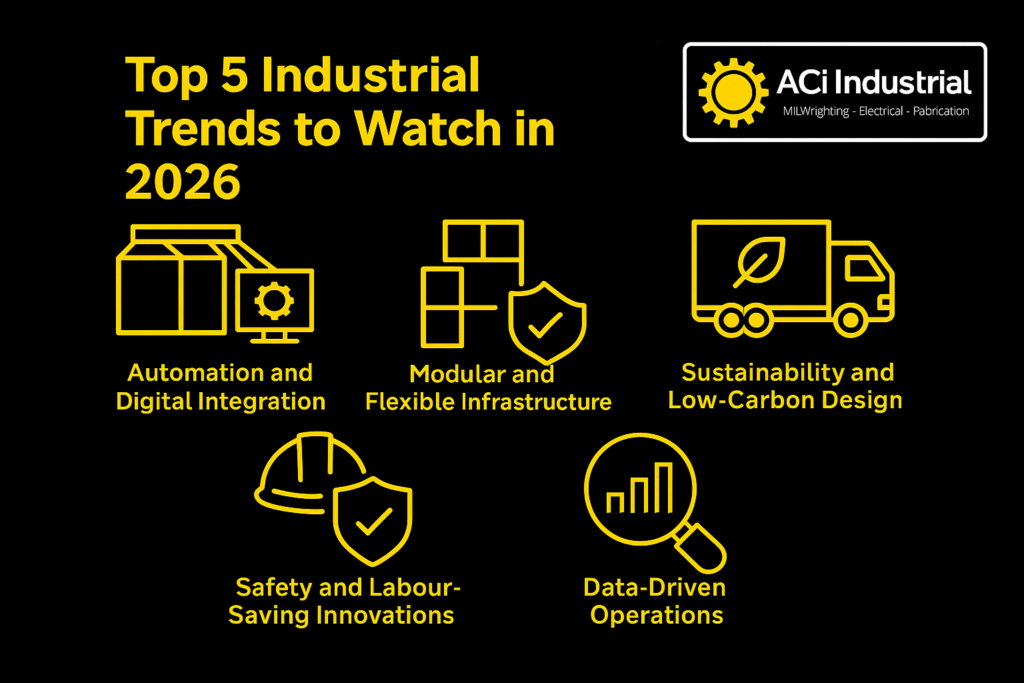
Branded ACi Industrial graphic showing the top five industrial trends for 2026, including automation, modular infrastructure, sustainability, safety innovations, and data-driven operations, with icons and ACi’s logo in ACi colours.
A visual overview of the five industrial trends shaping 2026: automation, modular infrastructure, sustainability, safety-focused design, and data-driven operations—presented in ACi Industrial’s colours and branding.

Automation and Digital Integration

Automation is no longer limited to high-tech plants.  Across industries, facilities are adopting advanced control systems and remote monitoring to improve efficiency and reduce downtime.  Digital integration allows operators to manage processes from centralized control rooms or mobile devices, creating faster response times and better visibility.

Modular and Flexible Infrastructure

Speed and adaptability are becoming essential.  Modular steel structures and prefabricated components are gaining popularity because they reduce on-site construction time and allow facilities to scale up or reconfigure as needs change.  This flexibility is especially valuable in sectors facing fluctuating demand or seasonal operations.

Sustainability and Low-Carbon Design

Environmental regulations and corporate responsibility initiatives are pushing companies toward greener practices.  Energy-efficient systems, optimized layouts, and sustainable materials are becoming standard considerations in industrial projects.  Logistics strategies are also evolving to reduce emissions and meet compliance requirements.

Safety and Labour-Saving Innovations

Worker safety remains a top priority.  Expect more emphasis on designs that minimize manual intervention, improve ergonomics, and reduce exposure to hazards like dust or confined spaces.  Automation and modular systems are playing a big role in reducing labour-intensive tasks and improving overall safety.

Data-Driven Operations

The rise of IoT sensors and predictive analytics is transforming maintenance and material handling.  Real-time data helps anticipate equipment failures, optimize storage, and improve decision-making.  This shift toward data-driven operations is enabling businesses to reduce downtime and improve efficiency without major overhauls.

Why These Trends Matter

These developments aren't just for large corporations, they're shaping best practices across the industrial and agribusiness landscape.  Staying informed can help you identify opportunities to improve safety, efficiency, and sustainability in your own operations.

Contact Us

ACi Industrial logoWant to learn more and discuss how these trends may impact your business operations?  Contact one of our team members today by calling 519 759 5880 (Brantford Office), or 613 652 1010 (Brinston Office), email sales@aci-industrial.com, or fill out the contact form below.
Contact Us

Agricultural Technology and Innovation, Farm Operations, Grain Handling Solutions, Industry Trends, Uncategorized

What’s Changing in Grain Handling and Why It Matters In 2026

Grain handling is evolving fast.  From smarter facilities to sustainability pressures, new technologies are reshaping how elevators, terminals, and large farms store and move grain.  If you’re exploring what’s new and how it could impact your operation, here are five trends to watch in 2026.

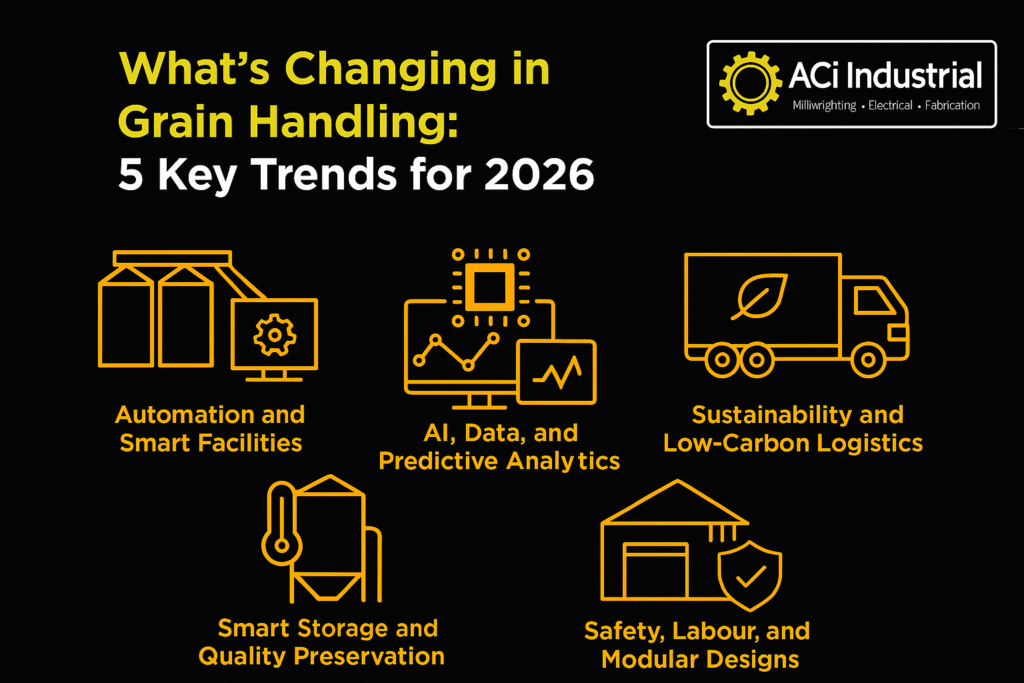
Illustration showing five key grain handling trends for 2026: automation and smart facilities, AI and predictive analytics, sustainability and low-carbon logistics, smart storage and quality preservation, and safety with modular designs.
Five major trends shaping grain handling in 2026: automation, AI-driven analytics, sustainability, smart storage, and safety-focused modular designs.

Automation & Smart Facilities

Facilities are moving beyond manual controls to automated receiving, conveying, drying and loadout.  What is the big benefit?  Fewer errors, more consistency, and less time spent on repetitive tasks.  Many sites now use centralized control rooms and remote monitoring so operators can engage with their systems from a distance, which boosts responsiveness and safety.

AI, Data, and Predictive Analysis

Integrating digital technologies is becoming practical in grain handling.  Teams are progressing from basic dashboards to prescriptive analytics that can suggest optimal storage allocation, material flow, and maintenance timing.  Predictive maintenance is gaining traction for equipment such as elevators, belts, dryers, and fans, which reduces downtime during harvest and protects margins.

Smart Storage and Quality Preservation

New bins and portable units use continuous sensors for temperature, moisture, even CO2 to flag issues before spoilage occurs.  These systems increasingly sync with farm and elevator software to update inventory automatically, trigger aeration, and support traceability, which is valuable for both compliance and customer trust.

Sustainability and Low-Carbon Logistics

Tighter emissions and carbon reporting rules are pushing shippers to optimize routes, consolidate loads, and shift more grain movements to rail/intermodal where practical.  Facilities and carriers are adopting fuel-efficient equipment and emissions-tracking tools to meet evolving national policies and reporting expectations.

Safety, Labour, and Modular Designs

Equipment design now emphasizes safer access, better guarding, and dust/explosion control, which reduces the need for workers to be on or inside structures.  Modular and mobile systems are gaining ground because they minimize on-site construction and adapt to varying seasonal or regional constraints.

Contact Us

ACi Industrial logoAre you curious about how these trends might apply to your operation?  Contact a team member today by calling 519 759 5880 (Brantford Office), or 613 652 1010 (Brinston Office), email sales@aci-industrial.com, or fill out the contact form below.

Contact Us

Serving the agricultural, commercial, and industrial sectors, ACi delivers solid turnkey projects. Off-the-shelf or custom solutions? Backed by our team of Engineers our Millwrights, Electricians, and Metal Fabricators, have the experience to turn your business idea into reality.

Contact Us