
Turning Insight In to Action: How to Finalize Your Facility Strategy
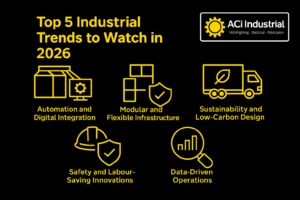
This article builds on our earlier review of the Top Industrial Trends for 2026 and the follow-up consideration-stage guide on how those trends influence facility planning. If you’ve reached the point of evaluating your options and preparing for an investment, this decision-stage version is designed for you.
Industrial organizations across Ontario and beyond are now moving from research to action. The trends driving change in 2026: automation, modular construction, sustainability, safety innovation, and data-driven operations are no longer theoretical. They influence how projects are scoped, what technology is selected, how timelines are structured, and which partners are most capable of delivering.
Below is a clear, decision-oriented breakdown of what companies should finalize as they prepare to move forward with upgrades, expansions, or new builds.
1. Automation & Digital Integration: Final Decisions to Make
Automation is no longer simply a competitive advantage, it’s an operational requirement. At this stage, organizations are determining which systems to integrate, how they will connect, and which vendor can ensure reliability and support.
Key decisions now include:
- Defining your controls architecture: PLC/SCADA standardization, communication protocols, and expansion capacity.
- Selecting equipment that supports data and automation rather than locking you into outdated or standalone systems.
- Confirming remote monitoring and cybersecurity requirements for your IT/OT environment.
- Finalizing fail-safe logic and E-stop integration to meet compliance.
At this stag, the question is no longer “Should we automate?” but “Who will implement it, and how do we future-proof it?”
2. Modular & Flexible Infrastructure: Aligning Design With Schedule & Budget
Modular and prefabrication approaches reduce downtime and construction risk, but each project requires choosing the right balance of prefab vs. site-built elements.
Decision-stage considerations:
- Confirming whether modular assemblies will reduce shutdown time enough to justify their use.
- Finalizing structural standards (steel gauge, coatings, load ratings, accessibility requirements).
- Coordinating modular components with civil, mechanical, and electrical scopes.
- Locking in realistic installation timelines that align with production seasons or turnaround windows.
This is the moment where conceptual layouts become construction-ready designs.
3. Sustainability & Low-Carbon Design: Selecting the Right Tactics
Most organizations now face clear emissions, reporting, or energy-efficiency expectations. Decision-makers are choosing which sustainability measures to implement and which to hold for future phases.
Common decisions at this stage:
- Whether to adopt energy-efficient fans, motors, lighting, or HVAC as part of the upgrade.
- Whether a site layout redesign can genuinely reduce internal traffic and fuel use.
- Selecting materials and building standards that support long-term sustainability metrics.
- Choosing systems that allow emissions data and energy use to be measured automatically.
Instead of exploring possibilities, this phase focuses on finalizing the strategies that align with your KPIs and compliance needs.
4. Safety & Labour-Saving Innovations: Engineering Out Risk
By the decision stage, most organizations have already assessed their high-risk areas. Now they must finalize which engineered controls and design choices will mitigate those risks.
Critical decisions include:
- Determining which elevated work areas require permanent access (stairs, platforms, catwalks).
- Finalizing guarding, dust control, and explosion mitigation systems.
- Selecting modular solutions that reduce construction time and limit worker exposure.
- Choosing workflow-driven interior fit-ups that reduce bottlenecks and improve throughput.
This is where safety moves from “planning” to implementation and verification.
5. Data-Driven Operations: Confirming the Digital Roadmap
At this stage, organizations have typically identified where data will create value. Now they must finalize their system architecture and technology stack.
Decision-phase checkpoints:
- Selecting the sensors, monitoring tools, and reporting platforms that best fit your operation.
- Confirming the data flow from equipment ->controls ->dashboards -> reporting
- Establishing maintenance and reliability metrics MTBF, MTTR, condition-based triggers).
- Ensuring scalability so future equipment integrates seamlessly.
This is where digital transformation becomes a defined, deliverable scope and not just a concept.
Bringing It All Together: Your 2026 Project Roadmap
If you’ve reached the decision stage, you’ve likely completed:
- Understanding the trends.
- Evaluating what matters to your facility.
- Outlining your goals and internal requirements.
Now your focus shifts to:
- Selecting the right partner(s).
- Finalizing project scope, timeline, and budget.
- Confirming standards, drawings, and specifications.
- Planning site preparation and construction sequencing.
- Booking fabrication, long-lead items, and installation windows.
This is where projects move from planning to execution.
Contact Us
 Want to learn more and discuss how to implement these trends in your business operations? Contact one of our team members today by calling 519 759 5880 (Brantford Office), or 613 652 1010 (Brinston Office), email sales@aci-industrial.com, or fill out the contact form below.